In the United States, healthcare startups face unique challenges when it comes to IT support. Unlike traditional businesses, these startups operate in environments where patient care, clinical workflows, and sensitive health data are closely intertwined. A robust IT help desk is no longer optional—it is a critical component for ensuring secure, compliant, and uninterrupted healthcare services. From HIPAA compliance and PHI protection to EHR integration, cloud infrastructure, AI-driven ticketing, and disaster recovery, building a scalable and resilient help desk is essential from day one.
What Is an IT Help Desk for Healthcare Startups in the US?
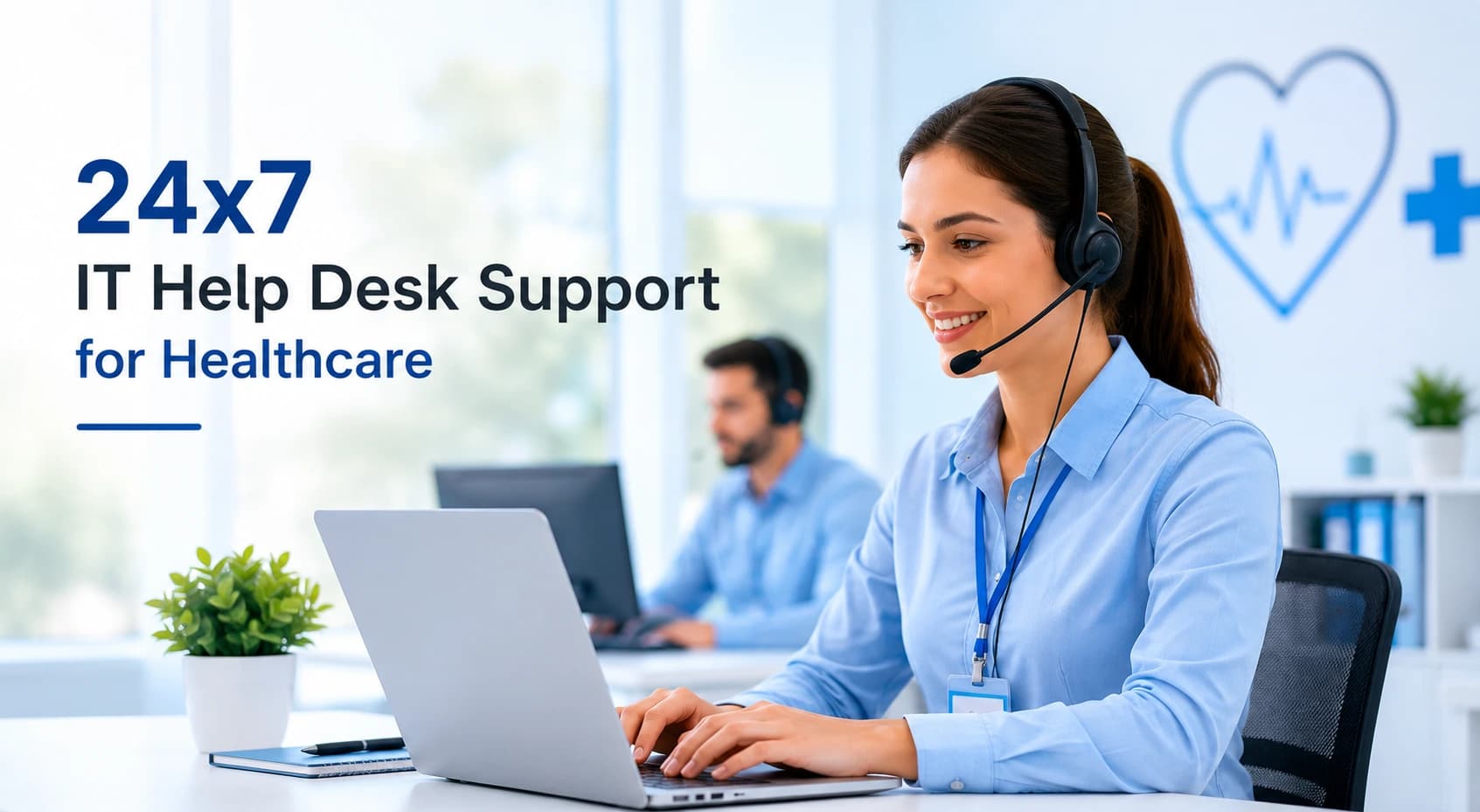
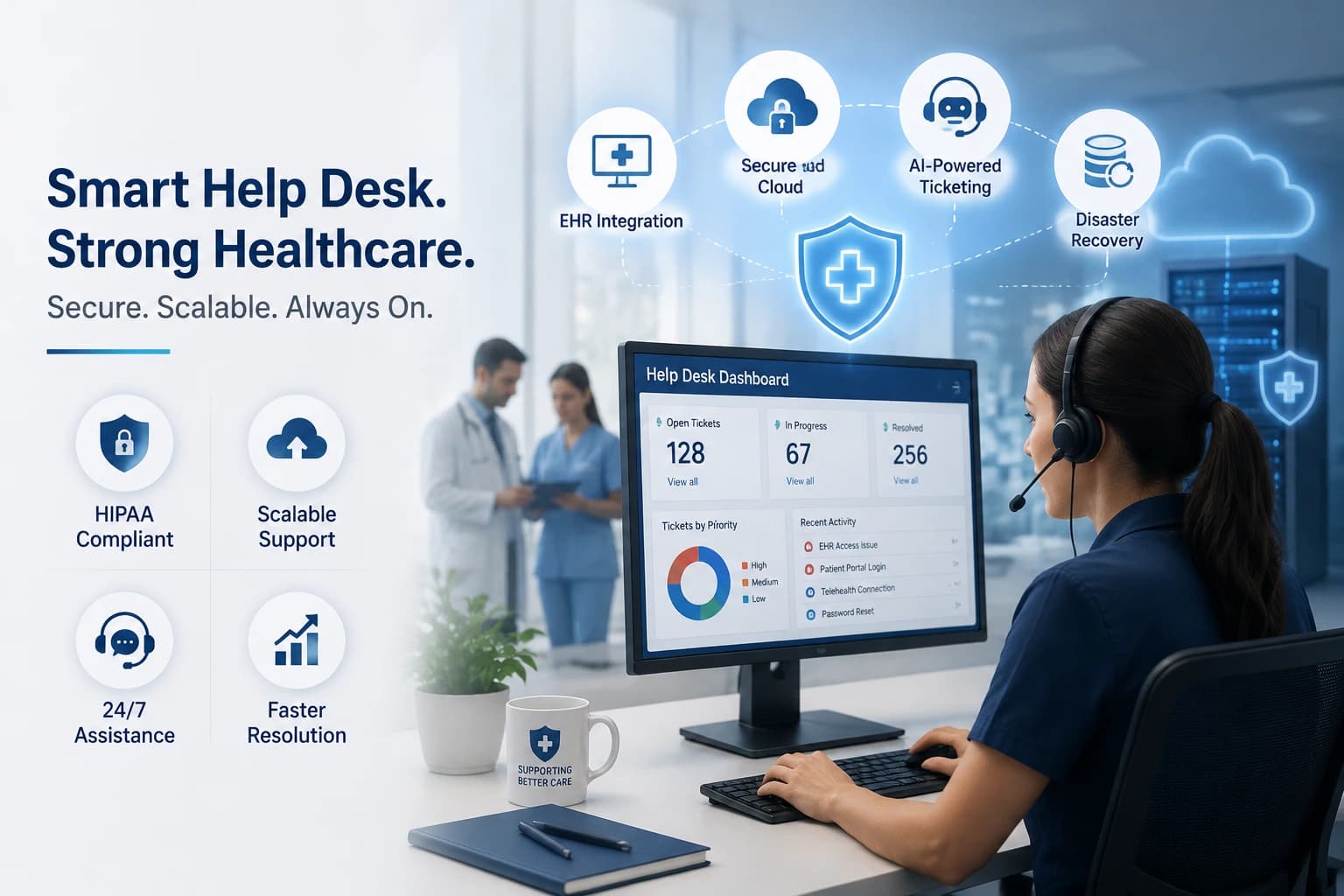
An IT help desk for healthcare startups acts as a centralized support hub that bridges the gap between technology platforms, clinical staff, and patients. Its primary function is to resolve technical issues efficiently, ensuring that telehealth applications, patient portals, and EHR/EMR systems run smoothly.
US-based startups benefit from a help desk that is tailored to the complexities of healthcare technology, including:
- Troubleshooting patient portal login issues and telehealth session errors
- Assisting providers with EHR access and clinical workflow challenges
- Supporting internal employees with hardware, software, and remote connectivity
A well-established IT help desk reduces downtime, enhances user satisfaction, and ensures that clinical operations remain uninterrupted.
Why US Healthcare Startups Need a Specialized IT Help Desk from Day One
Healthcare startups cannot rely on generic IT support. US healthcare regulations, particularly HIPAA, require secure handling of patient data from the outset.
Establishing a specialized help desk early ensures:
- Compliance with HIPAA and PHI protection standards
- Continuous support for patients and clinical staff
- Minimized operational risk during high-volume periods such as telehealth adoption or EHR migration
- Building trust with providers and patients through fast, reliable support
By implementing a tailored IT help desk, startups safeguard sensitive healthcare data while promoting a seamless experience for all users.
Core Functions of a Healthcare IT Help Desk
A healthcare IT help desk in the US typically covers the following core functions:
Patient & Provider Support
Resolving login issues, password resets, and portal navigation queries.
Ticketing & Incident Management
Tracking, prioritizing, and resolving technical problems efficiently.
Internal IT Support
Ensuring employees have functional devices, software access, and secure connections.
Software Troubleshooting
Handling EHR, telehealth, and clinical SaaS application errors.
AI-Driven Triage
Using automated tools to address high-frequency, low-complexity issues, freeing human agents for critical cases.
This comprehensive approach ensures both end-users and internal teams experience minimal disruptions.
HIPAA from Day One: Securing PHI in Every Support Ticket
HIPAA compliance is non-negotiable for US healthcare startups.
A help desk must:
- Use encrypted communication channels for all patient data
- Maintain audit logs for tracking ticket resolution and data access
- Implement role-based permissions to control sensitive information
- Ensure secure authentication methods such as SSO and MFA
These measures guarantee that Protected Health Information (PHI) remains safe while meeting strict regulatory requirements.
Scaling Healthcare Help Desk Operations for US Startups
Healthcare startups often experience unpredictable spikes in support requests, particularly during seasonal outbreaks, product launches, or patient onboarding surges.
Key Strategies for Scaling Include
Cloud-Based Ticketing
Platforms like Zendesk, ServiceNow, or Freshdesk can auto-scale to manage increased ticket volume.
Elastic Infrastructure
Automatically provision resources during peak periods.
AI Automation
Chatbots and Tier-1 automated triage resolve simple issues quickly.
Omnichannel Support
Ensures consistent service across phone, chat, email, and in-app communication.
Scalable help desk operations allow startups to grow without compromising patient care or overburdening clinical teams.
Cloud MSP Support for Healthcare Startups in the United States
Managed Service Providers (MSPs) play a pivotal role in US healthcare IT support.
Cloud MSP Services Provide
- Hosting and monitoring of healthcare applications
- Patch management and cybersecurity updates
- Endpoint management for remote and hybrid teams
- Ensured uptime and compliance with HIPAA regulations
Outsourcing cloud infrastructure management allows startups to focus on patient care while maintaining secure and reliable IT operations.
EHR and EMR Integration for Better Help Desk Support
Integrating the help desk with Electronic Health Record (EHR) and Electronic Medical Record (EMR) systems improves operational efficiency:
- Provides agents with real-time access to practitioner workspaces and recent clinical updates
- Enables faster troubleshooting of software or device issues
- Supports telehealth and patient portal integration
Popular US systems include Epic, Cerner, and Oracle Health, which help maintain continuity across clinical and administrative workflows.
ITSM, CMDB, and Asset Management for Healthcare Operations
Effective help desks integrate with IT Service Management (ITSM) tools and a Configuration Management Database (CMDB).
Benefits Include
- Maps all devices, workstations, and medical equipment
- Tracks dependencies to quickly identify the root cause of issues
- Optimizes workflows to reduce ticket resolution times
- Ensures compliance and proper documentation for audits
This structured approach enhances operational efficiency and reliability.
Secure Access Management: SSO, MFA, Active Directory, and Role-Based Access
Security is paramount for US healthcare startups.
Help desk platforms should:
- Implement Single Sign-On (SSO) for unified access
- Use Multi-Factor Authentication (MFA) to prevent unauthorized access
- Integrate with Active Directory for role-based user management
- Enable secure provisioning and deprovisioning of internal users
Such measures safeguard patient data while streamlining agent access to systems.
Real-Time Monitoring and Incident Escalation for Patient-Critical Systems
Healthcare IT systems are patient-critical.
Real-Time Monitoring and Incident Management Include
- SLA-based ticket prioritization to ensure urgent cases are addressed first
- Automated alerts for system failures or security incidents
- Tier 1, 2, and 3 incident escalation for efficient issue resolution
- Downtime detection and immediate response to minimize disruption
This proactive approach helps maintain patient safety and operational continuity.
Disaster Recovery for Healthcare Help Desk: Why US Startups Cannot Ignore It
Disaster recovery is crucial to ensure healthcare services remain operational during emergencies.
Key Benefits
- Protects against ransomware attacks, cloud outages, and power failures
- Maintains access to critical clinical systems
- Ensures uninterrupted patient care and provider workflows
A robust disaster recovery plan prevents catastrophic interruptions and builds trust with patients and staff.
DRaaS, Backup Solutions, RTO, RPO, and Geo-Redundant Recovery
Key Disaster Recovery Strategies Include
DRaaS (Disaster Recovery as a Service)
Cloud-based failover.
Geo-Redundant Backups
Backups across multiple US regions.
Recovery Time Objective (RTO)
Under one hour for critical systems.
Recovery Point Objective (RPO)
Targeting near-zero data loss.
Regular Testing
To ensure failover mechanisms are operational.
These measures guarantee rapid recovery and continuity in emergencies.
Business Continuity, Offline Fallback Procedures, and Regular DR Testing
Business continuity ensures that healthcare operations persist under any circumstances.
Essential Components
- Offline fallback procedures with encrypted secondary channels
- Staff training and simulated disaster drills
- Compliance audits and documentation to meet HIPAA and US regulations
- Maintaining clear communication with providers and patients during disruptions
A combination of proactive planning, redundant systems, and regular testing builds a resilient help desk infrastructure.
Conclusion
Healthcare startups in the US must prioritize secure, integrated, and scalable IT help desk solutions from day one. By combining HIPAA compliance, AI-driven ticketing, EHR integration, cloud MSP support, disaster recovery, and business continuity planning, startups can ensure reliable patient care, operational efficiency, and regulatory adherence.
Investing in a robust help desk infrastructure is not just a technical requirement it is a foundation for long-term growth, patient trust, and competitive advantage in the US healthcare market.
FAQs
1. What is an IT help desk for healthcare startups?
An IT help desk for healthcare startups is a centralized support hub that resolves technical issues for clinical teams, administrative staff, patients, and remote users. Unlike traditional IT support, healthcare help desks are designed to support patient-care technologies such as EHR systems, telehealth platforms, patient portals, digital prescription tools, and remote monitoring devices. They also prioritize clinical urgency, ensuring providers maintain uninterrupted access to critical patient information while meeting HIPAA compliance requirements. By acting as the primary point of contact for technical support, the help desk helps startups improve operational efficiency, reduce downtime, and support business growth.
2. Why do healthcare startups need specialized IT help desk support instead of general IT support?
Healthcare startups operate in highly regulated environments where technology directly impacts patient care and data security. A specialized healthcare IT help desk understands clinical workflows, healthcare software, HIPAA regulations, Protected Health Information (PHI), and the urgency associated with medical operations. Unlike general IT support, healthcare-focused teams can troubleshoot EHR access issues, telehealth disruptions, patient portal problems, and medical device connectivity challenges while maintaining compliance standards. This specialized expertise helps startups protect patient data, improve provider productivity, and maintain continuity of care.
3. What does scaling mean in a healthcare IT help desk environment?
Scaling refers to a healthcare help desk’s ability to grow and adapt as patient volumes, support requests, staff members, and healthcare applications increase. As healthcare startups expand, they often experience higher demand on EHR systems, patient portals, telehealth platforms, and support teams. Effective scaling may involve adding cloud resources, increasing server capacity, expanding support staff, implementing AI-powered ticket triage, and automating routine tasks. Whether through horizontal scaling (adding more systems) or vertical scaling (upgrading existing systems), a scalable healthcare help desk ensures performance, reliability, and patient support remain consistent during periods of rapid growth.
4. What is integration in a healthcare IT help desk, and why is it important?
Integration is the process of connecting healthcare technologies, applications, and support systems so they work together seamlessly. A modern healthcare IT help desk often integrates with EHR and EMR platforms such as Epic, Cerner, and Oracle Health, along with patient portals, pharmacy systems, laboratory systems, wearable devices, identity management solutions, and hospital management software. These integrations improve interoperability, enable Single Sign-On (SSO), provide faster access to patient information, and allow support teams to prioritize issues that directly affect patient care. Effective integration reduces workflow disruptions, improves user experiences, and supports more efficient healthcare operations.
5. What role does disaster recovery play in healthcare IT help desk operations?
Disaster recovery ensures healthcare organizations can quickly restore critical systems and continue operations during cyberattacks, hardware failures, cloud outages, power disruptions, or natural disasters. For healthcare startups, disaster recovery is essential because downtime can affect patient care, clinical workflows, and access to sensitive health information. A strong disaster recovery strategy includes secure backups, failover systems, Disaster Recovery as a Service (DRaaS), geo-redundant storage, incident response plans, and recovery testing. These measures help maintain uninterrupted access to clinical applications while protecting patient data and business operations.
6. How do RTO, RPO, failover, and failback support healthcare disaster recovery?
Recovery Time Objective (RTO) defines how quickly healthcare systems must be restored after an outage, while Recovery Point Objective (RPO) determines the maximum acceptable amount of data loss. Healthcare organizations typically require aggressive RTO and RPO targets because delays can directly affect patient care. Failover automatically transfers workloads and applications to backup systems when primary systems become unavailable, ensuring continuity of service. Once the primary environment is restored, failback returns operations to the original infrastructure. Together, these disaster recovery components help healthcare startups minimize downtime, protect Electronic Protected Health Information (ePHI), and maintain HIPAA compliance.
7. What are the key benefits of combining scaling, integration, and disaster recovery in a healthcare IT help desk?
When scaling, integration, and disaster recovery are implemented together, healthcare startups gain a resilient and future-ready support environment. Scalable infrastructure allows organizations to handle growing patient populations and support requests without performance issues. Integrated systems connect EHRs, telehealth platforms, medical devices, patient portals, and ticketing tools to create seamless workflows and improve operational visibility. Disaster recovery capabilities protect healthcare data, maintain service availability, and ensure rapid recovery during emergencies. Combined, these strategies help deliver continuous patient care, improve provider productivity, strengthen HIPAA compliance, reduce IT burden, and support long-term healthcare business growth.