Healthcare technology is moving faster than many clinics, hospitals, and digital health startups can safely manage alone. Cloud applications, remote teams, connected devices, AI tools, telehealth platforms, and patient portals now support daily care. At the same time, ransomware, outages, vendor failures, and data loss can interrupt operations within minutes.
That is why disaster recovery managed IT healthcare planning is becoming a core requirement, not a side project. A modern IT strategy must protect data, keep critical systems available, support business continuity, and help new healthcare companies build HIPAA from day one.
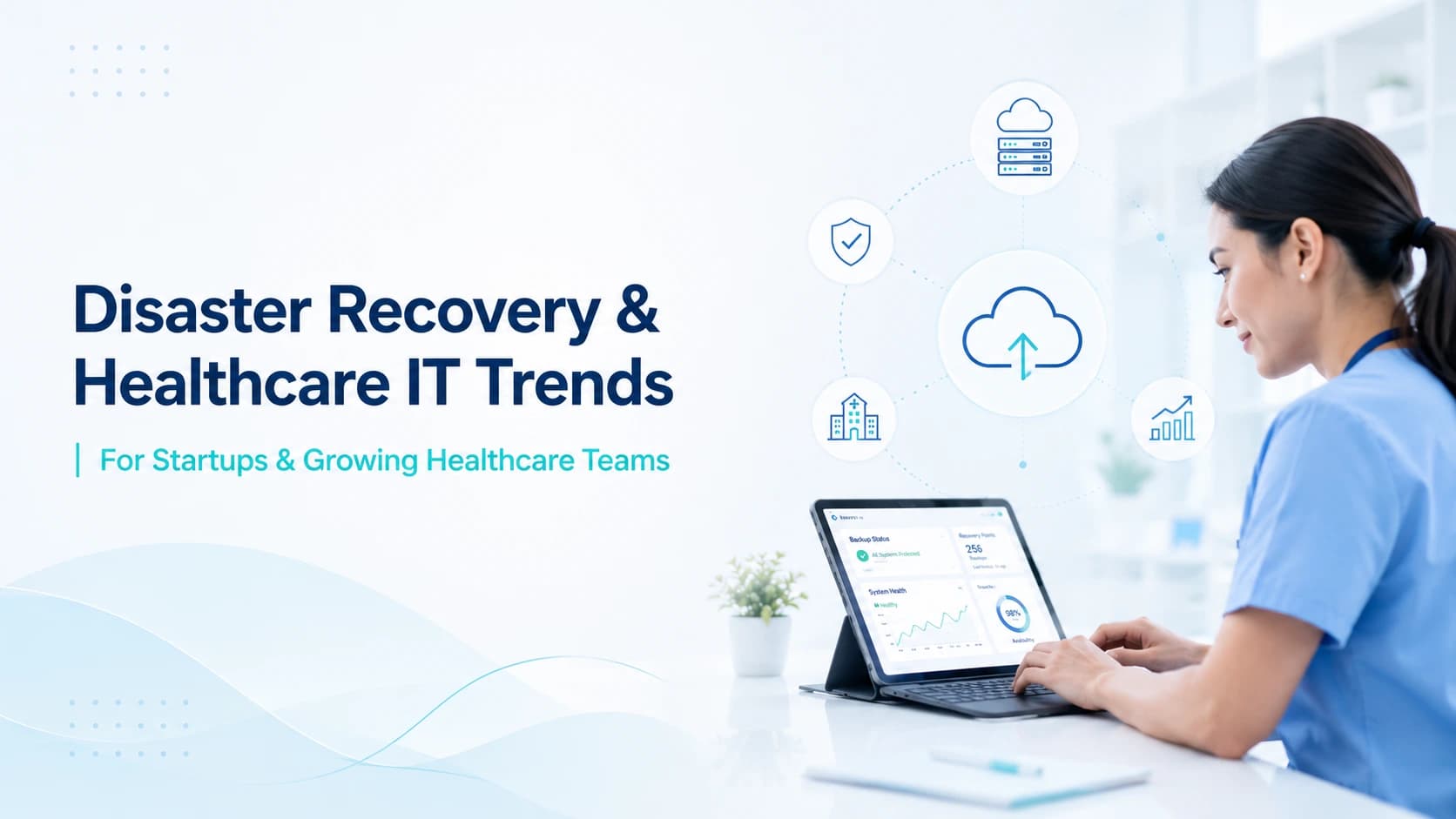
This guide explains disaster recovery, DRaaS, backup solutions, scalable infrastructure, digital health startup IT, and advanced healthcare IT trends that leaders should understand before choosing a managed IT partner.
Why Disaster Recovery Matters in Healthcare
Disaster recovery is the plan for restoring systems after disruption. In healthcare, disruption can mean ransomware, server failure, cloud outage, power loss, network downtime, accidental deletion, or vendor interruption.
The goal is not only to recover files. The goal is to restore patient-facing workflows quickly enough to protect care delivery, revenue, and trust. If staff cannot access scheduling, EHR systems, phones, billing tools, or clinical documents, the entire organization slows down.
Healthcare disaster recovery should identify critical systems, backup frequency, recovery targets, responsible teams, communication steps, and manual workarounds. Without a documented plan, recovery becomes guesswork during the worst possible moment.
Backup Solutions vs Disaster Recovery
Backups and disaster recovery are related, but they are not the same. Backups are copies of data. Disaster recovery is the full process for restoring operations.
A clinic may have file backups but no clear way to rebuild a server, reconnect users, validate data, or prioritize systems. That means the organization still has recovery risk.
Good backup solutions should include automated schedules, encryption where appropriate, offsite storage, monitoring, alerting, retention rules, and restore testing. Good disaster recovery adds system priorities, RTO RPO goals, vendor contacts, escalation, communication, and documented recovery steps.
For healthcare, both are needed.
Understanding RTO and RPO
Two terms shape every recovery plan. RTO means Recovery Time Objective. It defines how quickly a system must be restored after downtime. RPO means Recovery Point Objective. It defines how much data loss is acceptable.
For example, if a billing file share has an RPO of twenty four hours, losing one day of changes may be acceptable. If an EHR-connected workflow has an RPO of fifteen minutes, backups must run much more often.
Healthcare leaders should define RTO and RPO by workflow importance. Phones, scheduling, patient records, billing, imaging, and email may need different targets. Managed IT providers can help match technology with those recovery expectations.
DRaaS for Healthcare Organizations
DRaaS, or Disaster Recovery as a Service, gives organizations a managed recovery model. Instead of building every recovery system internally, a provider helps manage backup replication, recovery environments, testing, and restoration workflows.
DRaaS can be valuable for healthcare organizations that need faster recovery but do not have large internal IT teams. It may support servers, cloud workloads, applications, virtual machines, and critical data.
The value of DRaaS is not only technology. It also adds process. A strong provider should help document recovery steps, test restores, review reports, and adjust plans when systems change.
Business Continuity Beyond IT
Business continuity is broader than disaster recovery. It asks how the organization continues operating when technology is limited.
A healthcare continuity plan should cover appointment handling, patient communication, downtime forms, billing delays, staff instructions, leadership alerts, vendor updates, and alternate access methods.
For example, if the internet fails at one location, can phones still work? Can staff access schedules from another site? Can providers document care safely until systems return?
Managed IT supports continuity by designing resilient systems, but leadership must also define operational procedures. Technology and workflow planning must work together.
Healthcare Startup IT Challenges
Digital health startups face a different problem. They need to move quickly, but they cannot treat security and infrastructure as future tasks. Investors, providers, patients, and partners expect reliable systems from the beginning.
Digital health startup IT should cover secure cloud setup, identity management, device policies, access control, backup planning, logging, vendor review, endpoint protection, incident response, and documentation.
Many startups build products first and fix IT later. That creates risk. A better approach is to design scalable infrastructure and security habits from the first stage of growth.
HIPAA From Day One
Healthcare startups should think about HIPAA from day one if they create, receive, maintain, or transmit protected health information for covered entities or as business associates.
HIPAA readiness is not a single software setting. It includes administrative, physical, and technical safeguards, policies, risk analysis, access controls, auditability, training, business associate agreements, and incident procedures.
A managed IT provider cannot make a company compliant automatically. However, it can help create the technical foundation: secure accounts, MFA, encryption guidance, backup monitoring, endpoint protection, least privilege access, logging, and documentation.
Starting early is easier than rebuilding later.
Scalable Infrastructure for Growth
Scalable infrastructure allows healthcare organizations to add users, sites, apps, data, and workflows without breaking the environment.
For startups, this may mean cloud-native systems, secure identity management, role-based access, automated deployment, monitored backups, and documented architecture. For clinics, it may mean standardized devices, network planning, cloud migration, and centralized support.
Scalability should not only mean handling more traffic. It should also mean managing more security obligations, more support tickets, more vendors, and more reporting needs.
Managed IT helps by creating standards before growth becomes chaotic.
Advanced Healthcare IT Trend: Cloud Maturity
Healthcare organizations are no longer simply asking whether they should use the cloud. They are asking how to manage cloud systems safely.
Cloud maturity includes security configuration, access reviews, cost control, backup planning, data retention, logging, integration monitoring, and vendor management.
Many cloud tools are easy to start but difficult to govern. Without proper management, organizations may collect unused licenses, uncontrolled permissions, shadow IT, and unclear data locations.
In 2026, healthcare cloud strategy should focus on visibility, security, and operational control rather than simple migration.
Advanced Healthcare IT Trend: AI-Ready Operations
AI tools are entering healthcare operations, administration, documentation, analytics, patient engagement, and support workflows. Before using AI widely, organizations need strong IT foundations.
AI-ready operations require clean data access rules, identity controls, vendor review, logging, user training, and clear boundaries around sensitive information. Organizations should know which tools can access patient data and how outputs are reviewed.
Managed IT can support the technical side by controlling access, monitoring systems, documenting vendors, and helping leadership evaluate infrastructure impact. AI should be added to a mature environment, not used to hide weak IT processes.
Advanced Healthcare IT Trend: Zero Trust Principles
Zero trust is a security approach based on verification, least privilege, and continuous monitoring. It does not assume that users, devices, or networks are safe simply because they are inside the organization.
For healthcare, zero trust principles can include MFA, device compliance checks, role-based access, segmentation, strong logging, conditional access, and regular permission reviews.
This approach is useful for remote teams, cloud systems, multiple locations, vendors, and startup environments. It helps reduce risk when users work from different places and access many applications.
Advanced Healthcare IT Trend: Stronger Vendor Risk Management
Healthcare organizations depend on many vendors. EHR platforms, billing tools, payment systems, cloud providers, telehealth systems, labs, imaging platforms, and marketing tools may all touch operations.
Vendor risk management means knowing which vendors handle sensitive data, what access they have, how they protect systems, and how outages affect workflows.
Startups also need this discipline because early vendor choices can shape future compliance and security posture. A managed IT partner can help document vendors, review access, coordinate support, and identify dependency risks.
Advanced Healthcare IT Trend: Resilience Testing
A disaster recovery plan is weak if it is never tested. Resilience testing checks whether backups restore properly, users can reconnect, systems start in the right order, and teams know what to do.
Testing may include file restores, server recovery drills, tabletop exercises, cloud failover reviews, and ransomware response simulations.
Healthcare organizations should test recovery plans at least periodically and after major system changes. Testing builds confidence and exposes gaps before a real outage happens.
For startups, testing is also useful for investor, partner, and enterprise customer confidence.
What a Managed IT Provider Should Include
A healthcare managed IT provider should support disaster recovery, backup monitoring, endpoint protection, patch management, identity management, access control, cloud support, vendor coordination, help desk support, incident response, and reporting.
For advanced environments, the provider should also understand DRaaS, business continuity, scalable infrastructure, multi-site support, compliance readiness, and startup growth needs.
The best provider will not sell one generic package to every healthcare team. It will assess systems, risks, users, applications, recovery needs, and growth plans before recommending services.
How to Evaluate Disaster Recovery Readiness
Healthcare leaders can begin with practical questions. What systems are critical? How often are they backed up? Where are backups stored? Are backups encrypted? Who receives failure alerts? When was the last restore test? What is the RTO? What is the RPO? Who contacts vendors? How are staff updated during downtime?
If the answers are unclear, the organization needs stronger planning.
A managed IT assessment can help identify missing backups, outdated servers, weak permissions, undocumented vendors, untested restores, and recovery gaps.
Startup IT Roadmap for Digital Health Companies
A digital health startup should build IT in stages. First, establish secure identity, MFA, role-based access, endpoint protection, password management, cloud configuration, and basic documentation.
Second, add backup policies, logging, vendor review, incident response, and disaster recovery targets.
Third, prepare for scale with automation, formal policies, reporting, security reviews, infrastructure monitoring, and support workflows.
This staged approach helps startups move quickly without ignoring risk. It also makes future audits, partnerships, and enterprise sales easier because documentation already exists.
Common Mistakes to Avoid
Healthcare organizations often make the same mistakes. They assume backups are working without testing them. They keep old servers too long. They allow too many admin accounts. They delay documentation. They rely on one employee who knows everything. They accept vague vendor promises. They treat HIPAA as paperwork instead of operational discipline.
Startups may move even faster and create risk by using personal accounts, shared passwords, unmanaged laptops, unreviewed cloud tools, and informal access.
These mistakes are preventable with structured managed IT support.
Advanced Healthcare IT Trend: Identity Resilience
Identity has become one of the most important parts of healthcare resilience. If attackers steal credentials or disable account systems, staff may lose access even when applications and backups still work.
Identity resilience means protecting login systems, admin accounts, MFA methods, password resets, emergency access, and privileged permissions. It also means having a recovery plan if an identity provider, directory service, or cloud account is compromised.
Healthcare organizations should separate admin accounts from daily user accounts, review privileged access, protect service accounts, and document emergency procedures. Startups should build this discipline early because identity choices made during the first year often remain for years.
Advanced Healthcare IT Trend: Secure Remote and Hybrid Work
Healthcare work is no longer limited to one building. Billing teams, administrators, IT staff, consultants, telehealth providers, and startup employees may work from different locations. This flexibility creates productivity benefits, but it also adds security and support challenges.
Secure remote work should include managed devices, MFA, conditional access, endpoint protection, encrypted connections, patching, and clear rules for using patient data outside the office. Personal devices and shared home computers should not become the default access method for sensitive systems.
Managed IT providers can help design remote access that is practical for staff and safer for healthcare operations.
Practical Buying Checklist
Before selecting a provider, ask for a clear disaster recovery and managed IT checklist. The proposal should explain backup scope, restore testing, DRaaS options, RTO RPO targets, support hours, incident response steps, cloud responsibilities, startup support, and reporting.
Also ask how the provider handles growth. Can the plan support new users, new locations, new cloud tools, and higher security expectations? Can it help prepare a startup for enterprise customers, audits, or healthcare partnerships?
A good provider should explain risks in plain language, not hide behind technical terms. It should also define ownership during urgent incidents across teams and vendors clearly. It should also identify what is included, what is optional, and what requires a separate project.
For healthcare buyers, the strongest proposal is the one that connects technology decisions to continuity, security, patient care, and business growth.
How MediSure Solution Can Help
MediSure Solution helps healthcare organizations build more resilient IT operations through managed support, monitoring, backup visibility, infrastructure support, help desk workflows, incident response, and scalable service planning.
For clinics, hospitals, labs, and digital health teams, MediSure can help review current systems, identify risk, support continuity planning, and build a managed IT model that fits the organization’s size and growth plans.
The goal is to reduce downtime risk, improve support visibility, and help healthcare teams operate with more confidence.
Final Thoughts
Disaster recovery, startup infrastructure, and advanced healthcare IT trends all point to one lesson: healthcare technology must be planned before failure happens.
Backups, DRaaS, business continuity, HIPAA from day one, scalable infrastructure, cloud maturity, AI readiness, zero trust principles, vendor risk management, and resilience testing are now essential parts of modern healthcare IT.
The right managed IT partner can help healthcare organizations move from reactive support to proactive resilience. That means better preparation, faster recovery, clearer visibility, and stronger support for patient care.
If your organization needs disaster recovery managed IT healthcare support, backup solutions, startup IT planning, or scalable infrastructure guidance, MediSure Solution can help you build a safer and more reliable technology foundation.
FAQs
What is disaster recovery in healthcare IT?
Disaster recovery is the process of restoring healthcare systems, data, applications, and workflows after an outage, cyber incident, hardware failure, or data loss event.
What is DRaaS?
DRaaS means Disaster Recovery as a Service. It is a managed model where a provider helps replicate, protect, test, and restore critical systems.
Why do healthcare startups need HIPAA from day one?
Healthcare startups may handle sensitive patient data early. Building HIPAA readiness from the beginning reduces rework, risk, and partnership barriers later.
What is the difference between backup and business continuity?
Backup protects copies of data. Business continuity explains how the organization keeps operating during disruption.
How often should backups be tested?
Backups should be tested regularly and after major system changes. The schedule should match the risk level and recovery goals of the organization.
What does scalable infrastructure mean?
Scalable infrastructure can grow with more users, data, locations, apps, support needs, and security requirements without creating chaos.
Can managed IT support digital health startups?
Yes. Managed IT can help startups with secure cloud setup, access control, endpoint protection, backups, documentation, vendor review, and infrastructure planning.
Does managed IT guarantee HIPAA compliance?
No. Managed IT supports technical safeguards and readiness, but compliance also requires policies, training, risk analysis, leadership oversight, and legal review.