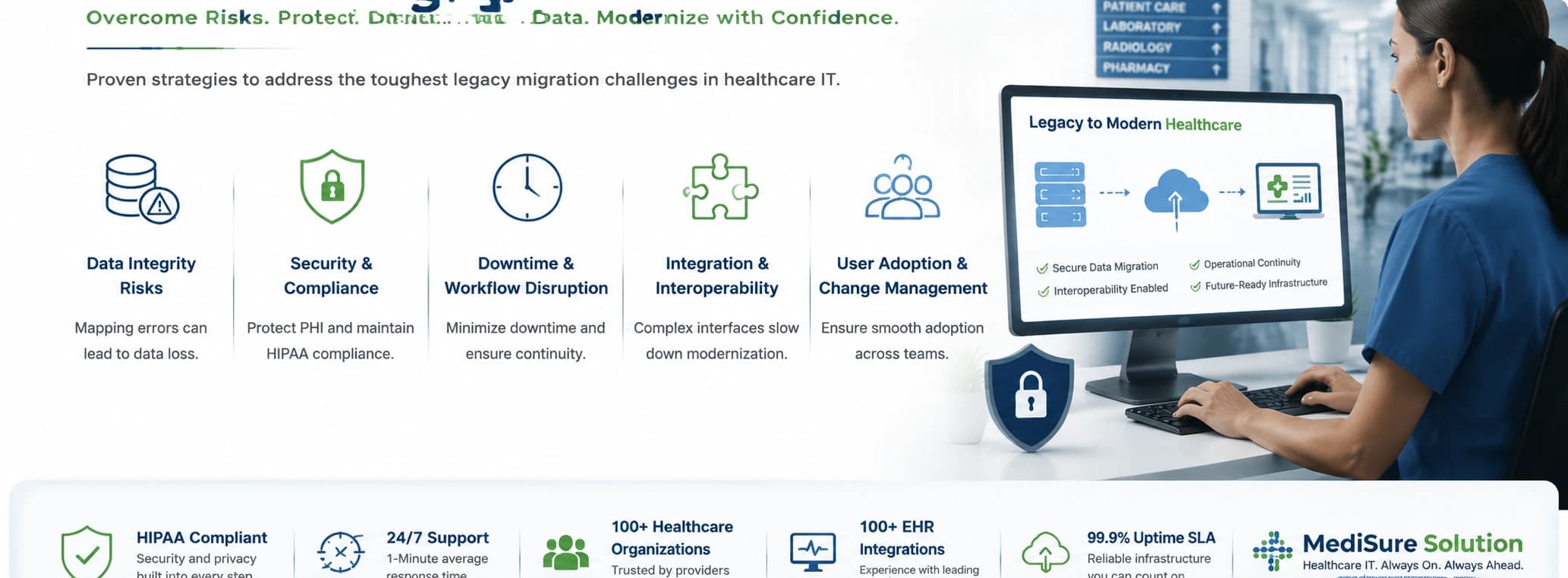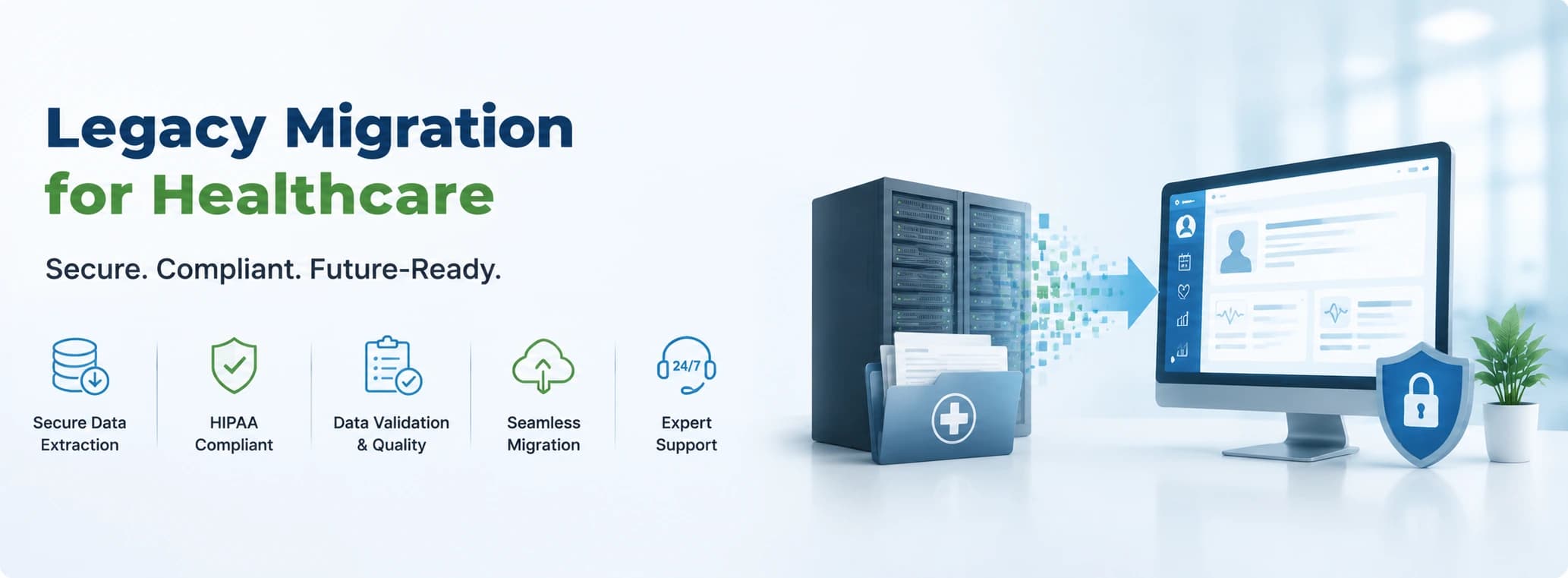
When a legacy system fails in a healthcare environment, the cost is not measured in dollars alone. Clinical documentation workflows slow down, interoperability gaps widen, historical records become difficult to access, and IT teams are forced into reactive firefighting rather than strategic modernization.
Industry estimates suggest that healthcare organizations are increasingly moving away from large-scale “big bang” replacements in favor of phased modernization strategies that prioritize incremental migration, API-driven integration, and cloud-enabled interoperability while maintaining HIPAA compliance and operational continuity (Thinkitive). At the same time, healthcare providers face growing pressure to modernize aging EHR platforms, laboratory systems, PACS environments, and administrative applications that were never designed for today’s connected healthcare ecosystem.
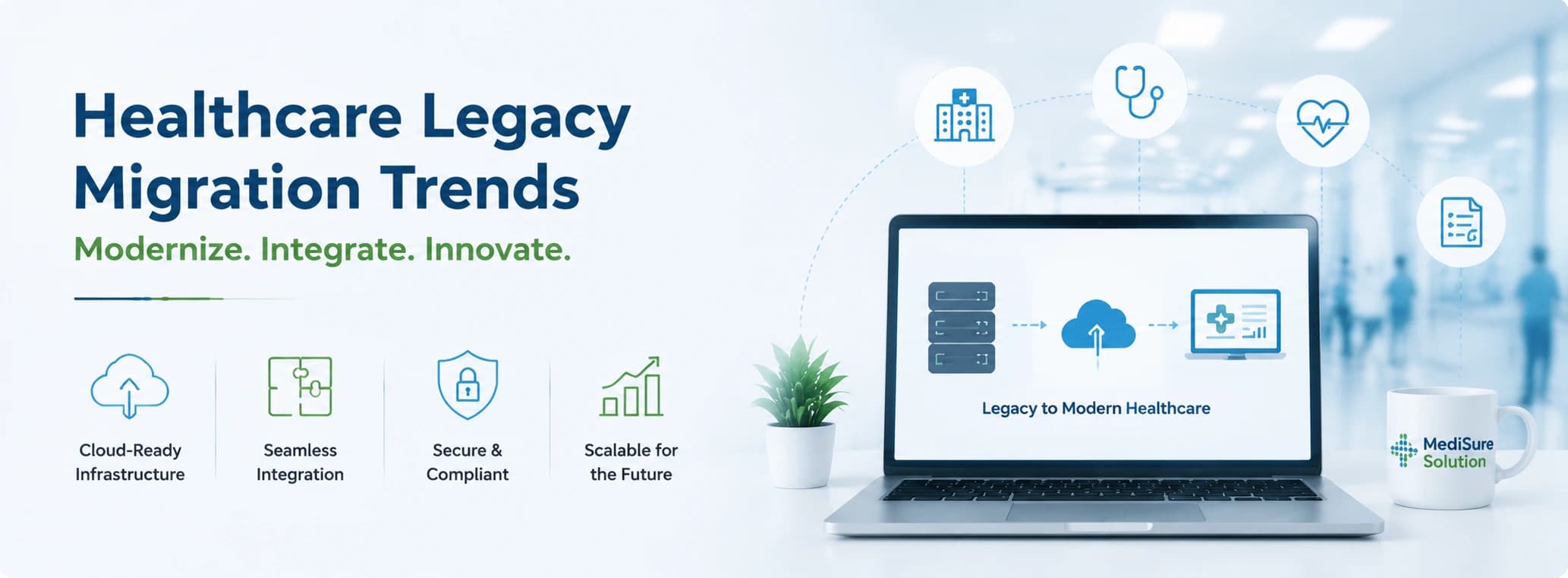
These evolving healthcare legacy migration trends reflect a broader shift in how hospitals, clinics, laboratories, and healthcare startups approach modernization. The organizations achieving the smoothest transitions are not replacing everything at once—they are modernizing strategically while preserving workflow continuity, regulatory compliance, and long-term data accessibility.
Healthcare Legacy Migration Trends & Best Practices Overview
| Category | Key Trend / Practice | Operational Impact in Healthcare IT |
|---|---|---|
| Migration Strategy | Phased migration instead of “big bang” cutovers | Reduces downtime risk, maintains clinical workflow continuity, and allows incremental validation across EHR, PACS, and LIS systems |
| Interoperability Focus | Adoption of HL7 FHIR, HL7 v2.x, CDA, DICOM standards | Enables seamless data exchange between EHRs (Cerner, Epic, Athenahealth), labs, imaging systems, and analytics platforms |
| Modern Architecture Shift | API-driven integration and middleware-based connectivity | Allows legacy systems to stay functional while connecting to cloud-native applications and modern healthcare platforms |
| Cloud Transformation | Hybrid and full cloud migration strategies | Improves scalability, disaster recovery, remote access, and infrastructure resilience for multi-site healthcare organizations |
| Modernization Pattern | “Strangler Fig” incremental replacement model | Gradually replaces legacy modules without disrupting critical hospital operations or clinical workflows |
| Data Integrity Approach | Discovery, auditing, and phased validation | Ensures accuracy of patient records, HL7/FHIR mapping, and historical data consistency during migration |
| Data Synchronization | Change Data Capture (CDC) and real-time syncing | Prevents duplication, data loss, and inconsistency across legacy and modern systems |
| Security & Compliance | HIPAA-aligned encryption, Zero Trust, audit logging | Protects PHI during migration and ensures regulatory compliance across all transformation phases |
| Testing Strategy | Sandbox testing + User Acceptance Testing (UAT) | Validates workflows, reduces deployment failures, and ensures clinical usability before go-live |
| Operational Continuity | Parallel system run + rollback planning | Ensures uninterrupted access to clinical systems and minimizes risk during cutover events |
Why Healthcare Organizations Are Struggling With Legacy Modernization
Healthcare IT leaders face a fundamental challenge: clinical teams need real-time, secure, interoperable access to information, while many legacy systems were designed for isolated workflows and limited integration requirements.
An IT Director managing multiple hospital campuses cannot easily modernize a decades-old EMR platform without considering downstream integrations, laboratory systems, PACS archives, and billing applications. A Clinical Informatics Manager responsible for interoperability initiatives often encounters legacy databases that lack support for modern interoperability frameworks such as HL7 FHIR. A clinic running eClinicalWorks alongside older third-party systems may struggle to balance regulatory compliance requirements with operational demands during a migration initiative.
The challenge becomes even greater when organizations pursue cloud transitions while maintaining uninterrupted access to clinical and administrative data. Many healthcare environments rely on custom integrations, undocumented workflows, and mission-critical applications that cannot tolerate prolonged downtime. As a result, modernization efforts frequently stall—not because leaders lack vision, but because the operational risks appear too high.
Why Phased Migration Has Replaced the “Big Bang” Approach
Healthcare organizations are increasingly discovering that modernization projects succeed when risk is distributed across manageable phases rather than concentrated into a single deployment event.
Large-scale system replacements often create significant pressure on infrastructure teams, clinical departments, and support staff. A hospital migrating from a legacy EHR to a modern platform such as Cerner or Athenahealth must coordinate application dependencies, user access controls, HL7 v2.x interfaces, CDA documents, reporting systems, and archival repositories. Attempting to replace all components simultaneously introduces unnecessary complexity.
Industry modernization guidance increasingly favors phased migration approaches that modernize systems incrementally while maintaining continuity of operations (Thinkitive, Sparity). This methodology allows organizations to validate workflows, verify integrations, and address compatibility concerns before expanding the scope of the project.
MediSure Solution has observed this trend across healthcare modernization engagements supporting hospitals, clinics, laboratories, and healthcare startups. With experience supporting more than 100 healthcare organizations and over 100 EHR integrations, phased deployment strategies consistently provide greater visibility into project risks while reducing operational disruption.
What this means for Healthcare CIOs and IT Directors is that modernization should be treated as a controlled transformation initiative rather than a single cutover event. Success is often determined by how effectively risk is managed between phases.
MediSure Solution’s Legacy Migration services help healthcare organizations modernize critical systems while maintaining operational continuity and HIPAA-aligned controls throughout every migration phase.
Why Interoperability Is Becoming the Primary Driver of Modernization
Many healthcare organizations initially begin modernization efforts because of aging infrastructure. However, interoperability frequently becomes the real business driver behind the project.
Legacy systems often create information silos that limit communication between EHRs, laboratory systems, imaging platforms, patient engagement tools, and analytics environments. Modern healthcare operations increasingly depend on seamless data exchange across platforms that support HL7 FHIR, HL7 v2.x, DICOM, and CDA standards.
Industry estimates suggest that healthcare modernization initiatives increasingly prioritize architectures aligned with FHIR-based interoperability and ONC Cures Act requirements (Thinkitive). Middleware platforms and API-driven integration strategies are also becoming central components of modernization roadmaps because they allow organizations to connect legacy environments with modern applications without immediate replacement of every system.
MediSure Solution’s experience integrating diverse healthcare environments demonstrates that interoperability challenges often extend beyond technology. Workflow dependencies, governance requirements, and historical data accessibility all influence migration decisions.
What this means for Clinical Informatics Managers and healthcare technology leaders is that modernization projects should be evaluated based on their ability to improve information exchange, not simply replace aging infrastructure.
Healthcare organizations seeking stronger interoperability can benefit from migration strategies that align legacy systems with modern healthcare integration standards and workflows.
Why API Wrapping Often Delivers Better Results Than Full Replacement
One of the most important healthcare legacy migration trends is the growing use of API-based modernization rather than complete application replacement.
Many healthcare organizations operate mission-critical applications that continue to perform core functions reliably despite aging architectures. Rebuilding these systems from scratch can introduce significant cost, complexity, and operational risk. In many cases, encapsulating legacy applications with modern APIs and middleware creates a practical path toward modernization without disrupting established workflows.
Industry guidance increasingly highlights API wrapping and encapsulation strategies as effective approaches for connecting legacy platforms with modern healthcare applications (Thinkitive). This allows organizations to bridge historical systems to cloud platforms, analytics environments, and interoperability frameworks while preserving critical business logic.
MediSure Solution frequently encounters environments where laboratory systems, administrative applications, and custom healthcare databases continue to provide operational value despite technical limitations. Strategic modernization often involves extending these systems rather than replacing them immediately.
What this means for healthcare executives is that modernization should not automatically be equated with replacement. The most effective strategy is often the one that balances operational continuity, cost efficiency, and future scalability.
Organizations planning healthcare modernization initiatives can reduce risk by evaluating integration-first migration strategies before committing to full application replacement projects.
Why Security Modernization Must Happen Alongside System Modernization
Legacy modernization projects frequently focus on application functionality while underestimating the importance of security architecture modernization.
Healthcare organizations continue to face increasing cybersecurity pressure, particularly when legacy systems contain unsupported operating systems, outdated authentication mechanisms, and limited audit capabilities. Modernization efforts that fail to address security simultaneously can leave organizations with upgraded applications but unchanged risk exposure.
Industry recommendations emphasize integrating end-to-end encryption, identity and access management controls, Zero Trust principles, and ongoing vulnerability assessments throughout modernization initiatives (Ralabs). For healthcare organizations handling Protected Health Information, HIPAA-aligned security controls must remain embedded throughout migration, testing, deployment, and post-migration operations.
MediSure Solution supports HIPAA compliance across all service offerings and applies healthcare-focused operational practices designed to protect sensitive data during modernization projects. Combined with a 99.9% uptime SLA and a one-minute average response time, these operational controls help organizations maintain resilience throughout complex infrastructure transitions.
What this means for Directors of IT Operations and Healthcare CIOs is that modernization projects should be evaluated as both technology initiatives and security initiatives. Separating the two often creates avoidable risk.
MediSure Solution helps healthcare organizations modernize infrastructure while maintaining secure, compliant, and resilient IT environments backed by 24/7 support.
MediSure Solution’s editorial content is developed by practitioners with direct experience supporting hospitals, medical centers, laboratories, pharmaceutical organizations, and healthcare startups across the United States. Our insights are grounded in real operational engagements involving EHR modernization, interoperability initiatives, cloud migrations, and healthcare infrastructure management—not theoretical frameworks.
Conclusion
Healthcare IT environments are under more pressure than ever before. Legacy systems continue to age while interoperability expectations, cybersecurity requirements, and regulatory obligations continue to expand across the healthcare sector.
Over the next two to three years, modernization strategies will increasingly focus on phased transformation, API-driven integration, cloud-enabled architectures, and interoperability frameworks built around HL7 FHIR and related standards. Organizations that begin planning now will be better positioned to reduce technical debt, improve operational efficiency, and support long-term scalability without disrupting critical workflows.
At MediSure Solution, we have seen firsthand how strategic modernization projects create stronger foundations for healthcare operations. We help hospitals, clinics, laboratories, healthcare startups, and pharmaceutical organizations navigate complex migration initiatives while maintaining uptime, security, and compliance. Whether the goal is legacy system retirement, cloud migration, interoperability improvement, or EHR modernization, we help organizations move forward with confidence.
MediSure Solution helps healthcare organizations stay operational, compliant, and ahead of downtime — get expert healthcare IT support at https://medisuresolution.com.
Frequently Asked Questions
What are the current healthcare legacy migration trends?
Current healthcare legacy migration trends include phased migration strategies, API-based modernization, cloud transitions, interoperability-focused architectures, legacy data archiving, and stronger cybersecurity integration throughout migration projects.
Why are healthcare organizations moving away from big-bang migrations?
Large-scale cutovers introduce significant operational risk. Phased migration approaches allow organizations to validate systems incrementally, reduce downtime exposure, and maintain workflow continuity throughout modernization efforts.
How does HL7 FHIR impact healthcare modernization?
HL7 FHIR enables more efficient data exchange between healthcare applications, making it a key component of interoperability initiatives. Many modernization projects prioritize FHIR-compatible architectures to improve information sharing and regulatory alignment.
What is the role of cloud transitions in healthcare legacy migration?
Cloud transitions help organizations improve scalability, resilience, disaster recovery capabilities, and infrastructure flexibility. Many healthcare providers are adopting hybrid or cloud-based models as part of broader modernization programs.
How can healthcare organizations maintain HIPAA compliance during migration?
Organizations should implement encryption, access controls, audit logging, identity management, vulnerability assessments, and documented governance procedures throughout the migration lifecycle to support HIPAA compliance.
Should every legacy healthcare application be replaced?
Not necessarily. Many organizations benefit from API wrapping, middleware integration, or selective modernization strategies that preserve valuable business functionality while improving interoperability and security.
What systems are commonly modernized in healthcare?
Common modernization targets include EHRs, EMRs, PACS environments, laboratory information systems (LIS), billing platforms, patient portals, administrative systems, and custom healthcare applications.
How long does a healthcare modernization project take?
Project timelines vary depending on infrastructure complexity, data volume, integration requirements, compliance considerations, and organizational readiness. Multi-facility healthcare environments often require phased deployments over several months.
What should healthcare leaders look for in a migration partner?
Healthcare organizations should prioritize partners with healthcare-specific experience, interoperability expertise, HIPAA-focused operational processes, migration planning capabilities, post-deployment support, and proven experience supporting healthcare technologies.
How does MediSure Solution support healthcare modernization initiatives?
MediSure Solution provides healthcare-focused legacy migration, EHR support, network management, server management, and 24/7 managed IT services. Our team supports more than 100 healthcare organizations with expertise across 100+ EHR integrations, HIPAA-aligned operations, and around-the-clock support.