When a healthcare system fails during a migration project, the cost is not measured in dollars alone. Clinical workflows slow down, historical records become harder to access, billing processes are disrupted, and IT teams face intense pressure to maintain continuity across departments.
Industry estimates and healthcare modernization initiatives consistently show that healthcare organizations are accelerating efforts to move away from unsupported legacy platforms while preserving critical historical data and operational workflows. Legacy systems often contain years of patient records, diagnostic imaging references, billing information, laboratory data, and custom business logic that cannot simply be discarded. At the same time, maintaining obsolete applications creates security, interoperability, and compliance challenges.
This reality makes understanding the most important legacy migration features healthcare organizations should demand from migration partners more critical than ever. The difference between a successful migration and a disruptive one often comes down to how effectively data is extracted, validated, secured, tested, and supported throughout the transition.
Why Healthcare Organizations Are Struggling With Legacy Data Migration Challenges
Healthcare organizations rarely operate within a simple technology environment. A regional hospital may maintain multiple EHR platforms, legacy laboratory information systems, PACS archives, billing applications, and departmental databases that have evolved over decades.
An IT Director managing five hospital locations cannot afford extended downtime while historical records are transferred from an aging platform to a modern environment. A Clinical Informatics Manager responsible for interoperability initiatives may discover that older systems store data in formats that do not align with current HL7 FHIR requirements. A clinic operating eClinicalWorks without dedicated migration expertise may struggle to maintain backward compatibility while introducing new workflows.
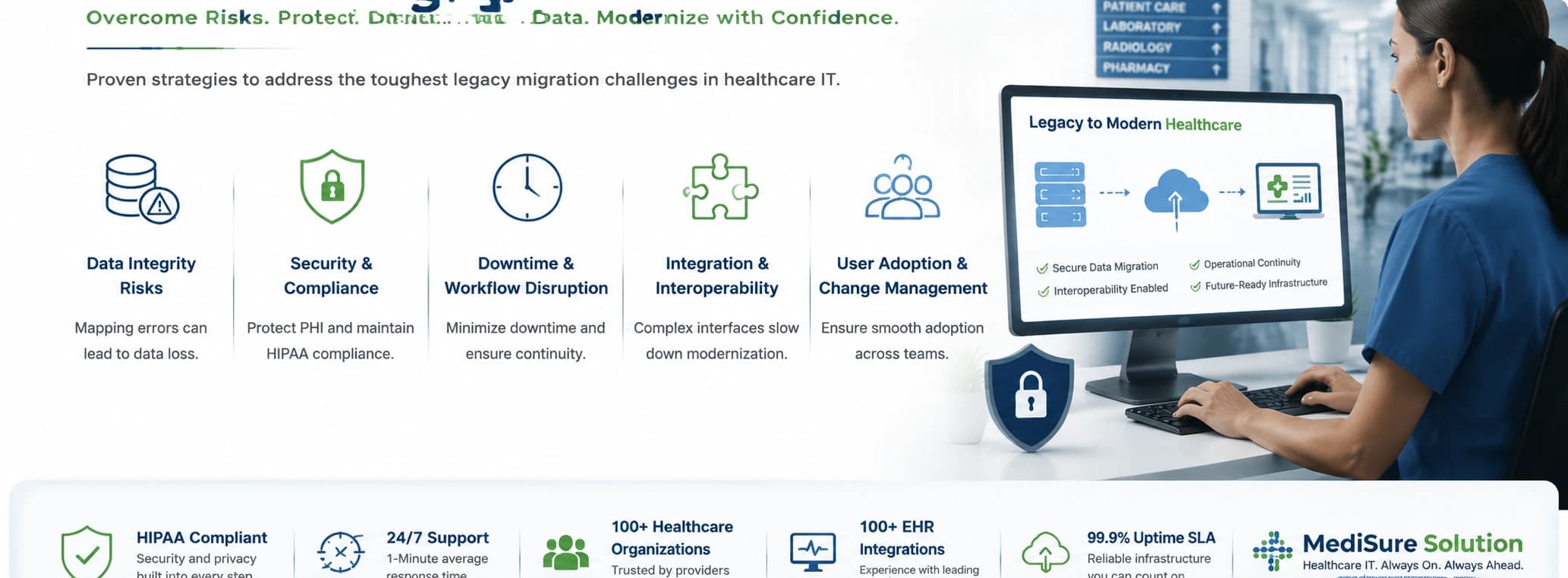
The challenge extends beyond moving information from one database to another. Healthcare organizations must ensure data validation, maintain auditability, execute comprehensive quality assurance, and establish tested rollback plans if unexpected issues arise. Legacy applications frequently contain customized workflows, proprietary schemas, and undocumented dependencies that make extraction significantly more complex than a standard IT project.
As healthcare systems modernize infrastructure, migration success increasingly depends on a structured approach that prioritizes operational continuity, compliance, and long-term accessibility of clinical information.
Key Features of Effective Healthcare Legacy Migration & Extraction Services
| Feature Category | Key Capabilities | Why It Matters in Healthcare IT |
|---|---|---|
| Regulatory Compliance & Security | HIPAA & HITECH alignment, encryption (data at rest & in transit), detailed audit trails, PHI access logging | Ensures patient data protection, regulatory compliance, and reduces breach risk during migration |
| Data Integrity & Mapping | Data validation, cross-system reconciliation, field mapping, duplicate detection, schema normalization | Prevents data loss, corruption, and ensures clinical accuracy across EHR transitions |
| Interoperability Standards | HL7 FHIR, HL7 v2.x, CDA, DICOM compatibility, standardized data transformation | Enables seamless communication between legacy systems and modern EHR platforms like Epic or Cerner |
| Legacy Data Archiving | Active/passive archiving, cloud-based storage, SSO-enabled access to historical records | Reduces cost by avoiding full migration while ensuring long-term access to historical patient data |
| Migration Strategy & Execution | Phased migration, module-based extraction, parallel system operation | Minimizes downtime and protects clinical workflows during system transitions |
| Clinical Continuity & Testing | User Acceptance Testing (UAT), workflow validation, rollback planning, change management support | Ensures uninterrupted patient care and safe go-live transitions |
| Integration Support | EHR integrations, LIS connectivity, billing systems, PACS and external API support | Maintains operational continuity across hospital-wide digital ecosystems |
Why Accurate Data Extraction Matters More Than the Migration Itself
The most successful healthcare migrations begin long before the first record is transferred. They start with a comprehensive assessment of the source environment and a disciplined extraction strategy.
Healthcare organizations often maintain data across EHR platforms such as Cerner, Athenahealth, and eClinicalWorks, alongside laboratory systems, imaging archives, and custom applications. Effective extraction tooling must identify dependencies, preserve relationships, and maintain contextual integrity throughout the migration process. Historical CDA documents, HL7 v2.x messages, DICOM metadata, and structured patient records all require different handling methodologies.
Industry best practices for modernization projects emphasize extracting raw source data before transformation activities begin. This approach creates an auditable baseline that supports reconciliation and validation throughout the migration lifecycle. Within MediSure Solution’s healthcare engagements, migration planning consistently prioritizes source-data preservation to ensure complete traceability during system transitions.
What this means for healthcare IT leaders is straightforward: migration success is rarely determined by the target platform. It is determined by whether the source data was extracted accurately enough to preserve operational continuity after go-live.
MediSure Solution’s Legacy Migration services help healthcare organizations securely extract and preserve critical historical data while maintaining HIPAA-aligned operational controls — explore the service at medisuresolution.com.
Why Data Validation and Quality Assurance Are Non-Negotiable in Healthcare Migrations
Healthcare organizations operate in environments where incomplete, duplicated, or improperly mapped records create operational risk. Migration teams must therefore treat validation as a core component of the project rather than a final checkpoint.
Effective migration programs include automated reconciliation processes, schema verification, duplicate detection, field-level mapping validation, and User Acceptance Testing (UAT). When migrating between systems that support HL7 FHIR, HL7 v2.x, CDA, or custom integrations, even minor inconsistencies can affect downstream reporting, interoperability initiatives, and administrative workflows.
Healthcare organizations increasingly recognize the importance of validating migrated records against source-system baselines before production cutover. This is particularly important when historical patient information, laboratory data, imaging references, and billing records must remain accessible after modernization efforts.
MediSure Solution’s operational experience supporting more than 100 healthcare organizations and over 100 EHR integrations provides firsthand insight into the complexities of healthcare data normalization and validation. Migration projects that incorporate structured quality assurance processes consistently reduce operational disruptions during deployment.
What this means for CIOs, Clinical Informatics leaders, and IT Operations teams is that validation should be viewed as an ongoing discipline throughout the migration lifecycle—not a task completed at the end of the project.
Healthcare organizations seeking dependable migration outcomes benefit from a structured validation framework supported by experienced healthcare IT specialists at MediSure Solution.
Why HIPAA Compliance, Auditability, and Security Must Be Embedded From Day One
Healthcare migrations involve Protected Health Information (PHI), making security and compliance central to every project decision.
Effective legacy migration services incorporate encryption for data at rest and in transit, role-based access controls, comprehensive audit trails, and documented chain-of-custody procedures. Whether migrating an EHR repository, laboratory database, PACS archive, or pharmaceutical research platform, organizations must maintain visibility into every data movement event.
Healthcare modernization initiatives increasingly focus on interoperability and cloud adoption. However, migration projects that prioritize speed over governance often create compliance exposure. Maintaining auditable records of extraction activities, transformation logic, validation outcomes, and user access events supports HIPAA requirements and strengthens organizational accountability.
MediSure Solution supports HIPAA compliance across all service offerings and applies healthcare-focused operational controls designed to align migration activities with regulatory expectations. Combined with a 99.9% uptime SLA and an average response time of one minute, healthcare organizations gain access to support structures that prioritize continuity and incident responsiveness during complex IT transitions.
What this means for healthcare executives is that compliance should not be treated as a separate workstream. Security, governance, and auditability must be integrated into every stage of the migration process.
Organizations planning large-scale healthcare migrations should ensure compliance controls are built into the project architecture from the beginning, not added after deployment.
Why Rollback Plans and Business Continuity Determine Migration Success
Many migration failures occur not because data transfer mechanisms fail, but because organizations underestimate the importance of recovery planning.
Healthcare operations cannot tolerate prolonged disruptions to scheduling systems, laboratory workflows, clinical documentation platforms, or administrative processes. Effective migration services therefore include staged deployments, incremental cutovers, disaster recovery validation, and documented rollback plans that can be executed quickly if unexpected compatibility issues emerge.
Organizations transitioning from legacy environments often choose phased migration approaches to minimize operational risk. This allows teams to validate functionality, monitor performance, and address integration concerns before broader deployment. Maintaining backward compatibility during transitional periods can also help organizations preserve critical workflows while new systems stabilize.
Industry modernization strategies increasingly favor controlled migration phases rather than single-event cutovers, especially in healthcare environments where interconnected systems must remain available. This approach aligns with established continuity planning principles focused on RTO, RPO, failover readiness, and service resilience.
What this means for healthcare decision-makers is that migration planning should focus equally on success scenarios and recovery scenarios. The ability to revert safely can be just as important as the ability to migrate successfully.
Healthcare organizations relying on continuous access to EHR, laboratory, and operational systems benefit from migration strategies designed around resilience, continuity, and rapid recovery.
Why Post-Migration Optimization Is Just as Important as Go-Live
Many organizations consider a migration complete once data appears in the new platform. In reality, go-live marks the beginning of a critical optimization phase.
Healthcare IT teams must monitor application performance, integration reliability, workflow efficiency, and user adoption after deployment. Newly migrated systems frequently require performance tuning, interface optimization, storage adjustments, and ongoing support to ensure operational objectives are achieved.
Organizations that invest in post-migration monitoring are better positioned to identify issues affecting interoperability, reporting accuracy, and application responsiveness before they impact operations. This is especially important when integrating modern cloud environments, EHR platforms, analytics tools, and healthcare startup technologies.
MediSure Solution’s experience supporting hospitals, clinics, laboratories, healthcare startups, and pharmaceutical organizations demonstrates that long-term migration success depends on sustained operational support. With 24/7 coverage, healthcare-focused escalation processes, and experience across complex healthcare environments, post-migration optimization becomes an extension of the modernization strategy rather than an afterthought.
What this means for healthcare leaders is that migration projects should include operational support plans extending well beyond the cutover date.
MediSure Solution provides healthcare-focused support services that help organizations maintain stability and performance long after migration projects are completed.
MediSure Solution’s editorial content is developed by practitioners with direct experience supporting hospitals, medical centers, laboratories, and healthcare startups across the United States. Our insights are grounded in real operational engagements involving healthcare infrastructure, EHR ecosystems, interoperability initiatives, and legacy modernization projects—not theoretical frameworks.
Preparing for the Next Generation of Healthcare IT
Healthcare IT environments are under more pressure than ever before. Legacy applications continue to age, interoperability requirements continue to expand, and healthcare organizations face growing expectations around security, compliance, and operational resilience.
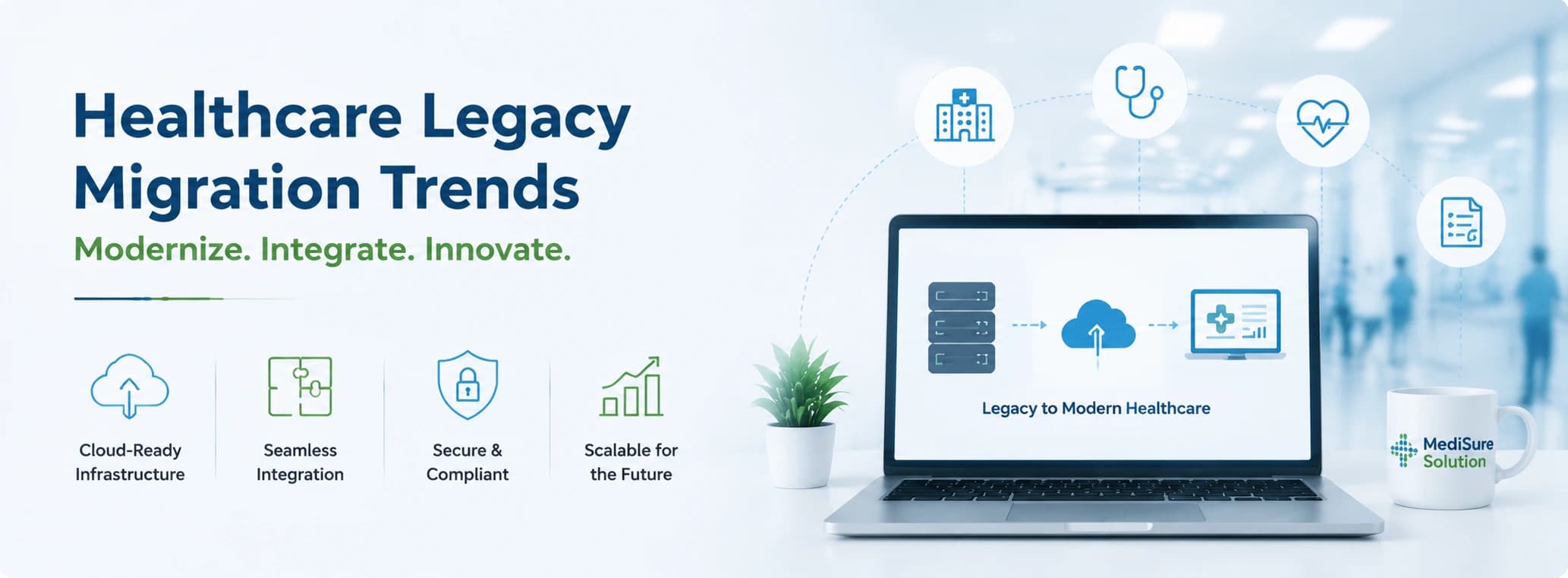
Over the next several years, healthcare systems will continue investing in cloud infrastructure, interoperability frameworks such as HL7 FHIR, advanced analytics platforms, and modern EHR ecosystems. Organizations that delay modernization efforts may find themselves managing increasing technical debt, escalating support costs, and greater operational complexity.
The organizations achieving the smoothest transitions will be those that prioritize comprehensive data extraction, rigorous validation, HIPAA-aligned governance, tested rollback strategies, and sustained post-migration support. Effective migration is not simply about moving data—it is about preserving operational continuity while creating a foundation for future growth.
At MediSure Solution, we help hospitals, clinics, laboratories, healthcare startups, and pharmaceutical organizations stay operational, compliant, and ahead of downtime through healthcare-focused migration expertise and around-the-clock IT support. We invite you to explore how our team can support your next modernization initiative and help ensure your critical healthcare systems remain secure, accessible, and resilient.
You can extend the blog with the following Conclusion and FAQ section placed after the main content.
Conclusion
Healthcare organizations can no longer afford to treat legacy migration as a simple data transfer project. Modern healthcare environments depend on continuous access to clinical, operational, financial, and compliance-related information across interconnected systems. Whether the migration involves an aging EHR, laboratory information system, PACS archive, billing platform, or custom healthcare application, success depends on much more than moving records from one database to another.
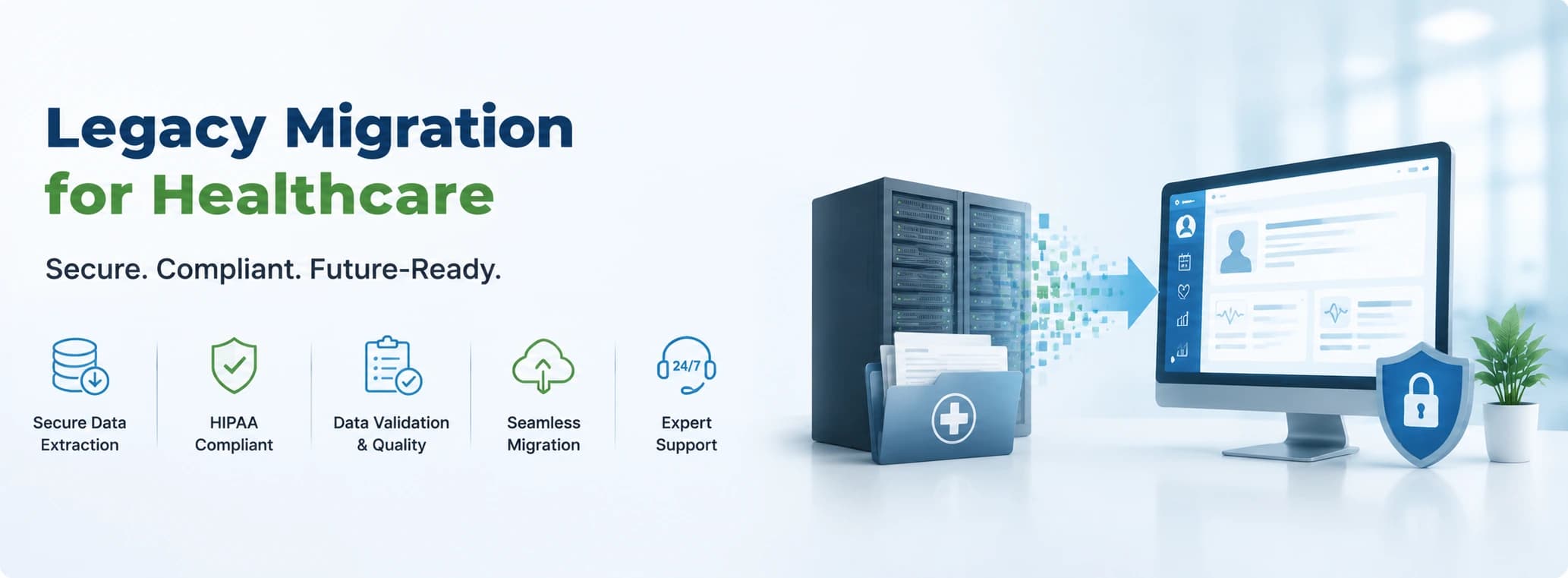
The most effective legacy migration and extraction services combine comprehensive system assessment, secure data extraction, rigorous validation processes, HIPAA-aligned governance, rollback planning, and ongoing optimization support. These capabilities help healthcare organizations modernize infrastructure while maintaining workflow continuity, regulatory compliance, and operational resilience.
As healthcare technology continues to evolve toward cloud-native platforms, interoperability standards such as HL7 FHIR, and advanced analytics initiatives, organizations that establish a strong migration foundation today will be better positioned to support future innovation. Delaying modernization often increases technical debt, security exposure, and maintenance costs.
MediSure Solution helps hospitals, clinics, laboratories, healthcare startups, and pharmaceutical organizations navigate complex migration projects with confidence. Backed by a 99.9% uptime SLA, 1-minute average response time, experience supporting 100+ healthcare organizations, and expertise across 100+ EHR integrations, our team delivers migration strategies designed to protect critical healthcare data while minimizing operational disruption.
Ready to modernize your healthcare systems? Contact MediSure Solution today to discuss your legacy migration and extraction requirements.
FAQs
What is legacy migration in healthcare?
Legacy migration in healthcare refers to the process of transferring clinical, administrative, financial, and operational data from outdated or unsupported systems to modern platforms. This may include migrating data from legacy EHRs, EMRs, laboratory systems, PACS archives, billing applications, or custom healthcare software while maintaining compliance, accessibility, and data integrity.
Why is data validation important during a healthcare migration?
Data validation ensures that records transferred from a legacy system remain complete, accurate, and usable in the new environment. Validation processes typically include reconciliation testing, field mapping verification, duplicate detection, quality assurance reviews, and User Acceptance Testing (UAT) before production deployment.
How can healthcare organizations minimize downtime during migration?
Downtime can be minimized through phased migration strategies, incremental cutovers, parallel system operation, failover planning, and comprehensive rollback procedures. These approaches help maintain access to critical healthcare systems while migration activities are underway.
What role does HIPAA play in legacy migration projects?
HIPAA governs the protection of Protected Health Information (PHI) throughout the migration lifecycle. Effective migration services incorporate encryption, access controls, audit logging, data governance policies, and secure transfer mechanisms to support HIPAA compliance and reduce security risks.
What is the difference between data extraction and data migration?
Data extraction involves retrieving information from a legacy system and preserving it in a usable format. Data migration includes extraction as well as transformation, mapping, validation, loading, testing, and optimization within the target environment. Extraction is one phase of the broader migration process.
How do healthcare organizations ensure compatibility between old and new systems?
Organizations maintain compatibility through detailed data mapping, interface testing, standards-based integrations, and support for interoperability frameworks such as HL7 FHIR, HL7 v2.x, CDA, and DICOM. Maintaining backward compatibility is often critical during phased migrations.
What are rollback plans, and why are they important?
Rollback plans are documented procedures that allow organizations to revert to a previous system state if unexpected issues occur during migration. They serve as a safety mechanism that protects operational continuity and reduces risk during deployment activities.
How long does a healthcare legacy migration project typically take?
Project timelines vary based on data volume, system complexity, integration requirements, compliance considerations, and organizational readiness. Smaller clinic migrations may take weeks, while multi-facility hospital migrations involving EHRs, PACS, and laboratory systems can span several months.
What should healthcare leaders look for in a migration partner?
Healthcare organizations should evaluate migration partners based on healthcare-specific experience, HIPAA expertise, validation methodologies, interoperability knowledge, rollback planning capabilities, post-migration support, SLA commitments, and familiarity with platforms such as Cerner, Athenahealth, eClinicalWorks, and other healthcare technologies.
How does MediSure Solution support healthcare legacy migration projects?
MediSure Solution provides healthcare-focused legacy migration and extraction services designed to securely transfer data from outdated systems while minimizing disruption. Our team supports hospitals, clinics, laboratories, healthcare startups, and pharmaceutical organizations with migration planning, data extraction, validation, compliance-focused processes, and ongoing operational support backed by a 99.9% uptime SLA and 24/7 coverage.