When healthcare IT systems fail, the disruption is not limited to infrastructure—it directly affects clinical workflows, diagnostics, and care coordination. A delayed EHR response, unavailable imaging data, or failed network dependency can slow down entire hospital operations.
Industry analysis from healthcare IT governance studies and compliance frameworks (HIMSS-aligned guidance and HHS cybersecurity recommendations) consistently highlights that system availability, incident response speed, and vendor accountability are now core pillars of safe healthcare operations.
This is why SLA management healthcare has evolved from a contractual concept into a critical operational discipline for hospitals, clinics, laboratories, and healthcare technology organizations.
Modern healthcare environments depend on tightly integrated systems like Cerner, Athenahealth, eClinicalWorks, HL7 FHIR interfaces, PACS imaging systems, and cloud-hosted EHR platforms. When any layer fails, the entire clinical chain is affected.
Why Healthcare IT Teams Struggle With SLA Control in Multi-Vendor Environments
Healthcare IT environments are no longer centralized. A single hospital may depend on 20+ vendors across infrastructure, applications, cybersecurity, cloud hosting, and integration layers.
An IT Director managing multiple facilities cannot manually track SLA compliance across every vendor while also handling uptime pressure, cybersecurity incidents, and clinical system dependencies.
Similarly, clinics using eClinicalWorks often operate with separate vendors for network support, hosting, backups, and EHR support—each with different response structures and escalation paths. When systems fail, accountability becomes unclear.
Healthcare startups face an even more complex challenge. As HL7 FHIR-based integrations scale across multiple APIs, monitoring SLA performance across distributed systems becomes increasingly difficult without structured governance.
The real issue is not SLA availability—it is SLA fragmentation, lack of enforcement, and absence of unified performance visibility across clinical systems.
Healthcare SLA Management: Key Principles & Practices
| Category | Key Requirements | Operational Impact in Healthcare IT |
|---|---|---|
| Healthcare-Specific Requirements | PHI encryption, access controls, HIPAA-aligned documentation, breach notification procedures | Protects patient data, ensures regulatory compliance, and reduces legal risk during system downtime or migration |
| Response & Resolution | Clinical-severity–based SLAs (e.g., 1–15 min for critical systems), clearly defined MTTR, RTO objectives | Guarantees timely restoration of life-critical systems like EHR, PACS, and LIS |
| Legal & Compliance Alignment | Pair SLAs with Business Associate Agreements (BAAs), audit logging, enforceable penalties | Holds vendors accountable for uptime, performance, and compliance adherence |
| Performance Metrics | Measurable uptime (often 99.99%), system availability, escalation paths, service credits | Provides quantifiable guarantees to maintain operational continuity across hospitals and labs |
| Monitoring & Verification | Independent tracking tools, recurring reviews (quarterly/biannual), continuous audits | Confirms SLA compliance, prevents hidden downtime, and strengthens governance |
| Risk Mitigation | Proactive monitoring, defined exemptions, force majeure clauses, backup strategies | Reduces impact of unexpected outages, cyber incidents, or infrastructure failures |
| Operational Integration | Tie SLA response to clinical severity rather than generic IT metrics | Ensures patient safety and uninterrupted clinical workflow across multi-site healthcare environments |
Why Generic IT SLAs Fail in Clinical Healthcare Systems
Most traditional SLAs are designed for enterprise IT environments where downtime affects productivity—not patient care. Healthcare environments operate under entirely different risk conditions.
A Cerner outage, PACS delay, or EHR disruption impacts real-time clinical decisions. These systems rely on HL7 v2.x messaging, CDA documentation flows, and DICOM imaging transfers where even short delays create operational bottlenecks.
Healthcare organizations increasingly require stricter benchmarks such as 99.99% uptime for mission-critical systems, along with clearly defined Recovery Time Objectives (RTO) and Recovery Point Objectives (RPO).
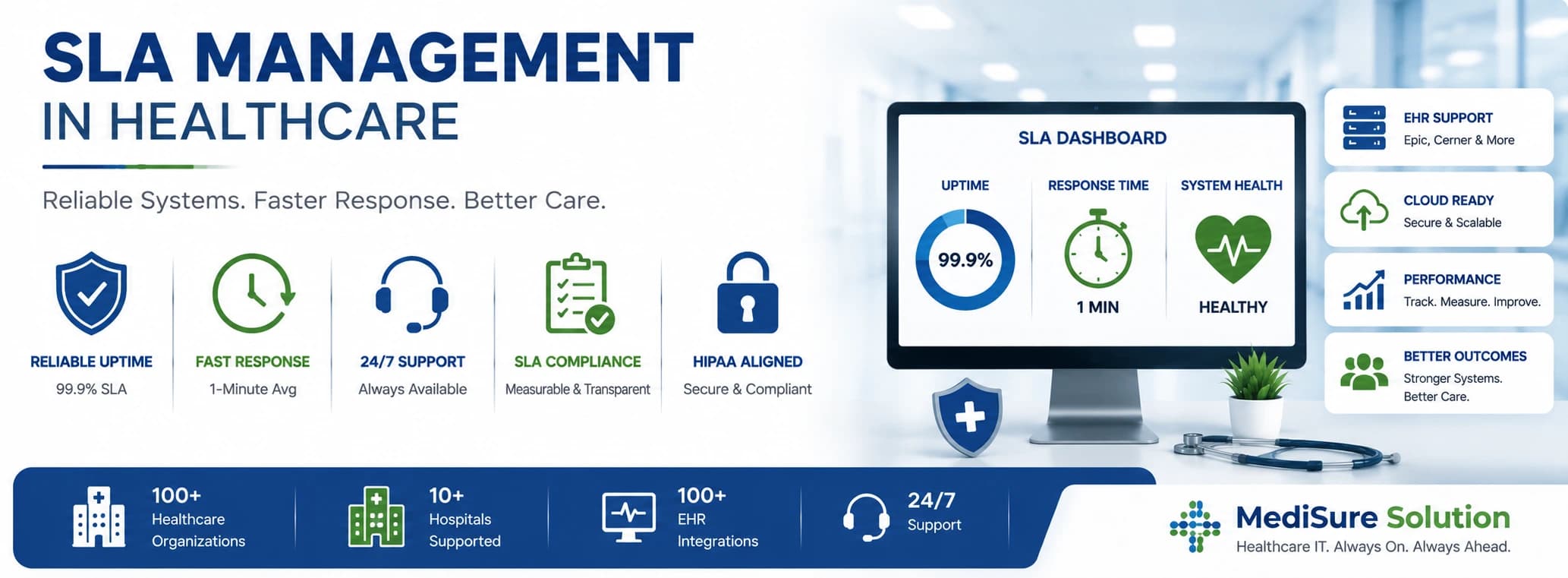
MediSure Solution has supported 100+ healthcare organizations and 10+ hospitals where SLA redesign was necessary to align vendor performance with clinical reality.
MediSure operates with a 99.9% uptime SLA designed specifically for healthcare IT environments where downtime tolerance is minimal.
Why Missing SLA Metrics Create Hidden Clinical and Operational Risk
Most SLA failures in healthcare are not caused by downtime—they are caused by undefined expectations during downtime.
A vendor may guarantee uptime but fail to define:
- incident response time
- escalation triggers
- patch deployment urgency
- breach notification timelines
- recovery communication structure
These missing elements create operational blind spots, especially in HIPAA-regulated environments.
Healthcare cybersecurity frameworks consistently emphasize that SLA governance must include measurable response structures, not just availability guarantees.
Healthcare SLA Performance Framework
| SLA Component | Recommended Target | Operational Impact |
|---|---|---|
| Critical Incident Response | ≤ 15 minutes | Enables rapid containment of system disruptions and minimizes clinical workflow interruptions |
| System Uptime | 99.9% – 99.99% | Ensures continuous availability of EHR, PACS, LIS, and other critical healthcare systems |
| Recovery Time Objective (RTO) | ≤ 4 hours | Facilitates fast restoration of critical systems after failures or outages |
| Recovery Point Objective (RPO) | ≤ 60 minutes | Reduces risk of data loss during incidents, safeguarding patient records and operational data |
| Critical Patch Deployment | ≤ 24 hours | Protects systems against known vulnerabilities and strengthens cybersecurity posture |
| Zero-Day Threat Response | ≤ 4 hours | Mitigates emerging threats before they impact clinical operations or patient data |
| SLA Escalation Trigger | 75% of SLA threshold | Ensures proactive escalation to prevent SLA violations and maintain compliance |
MediSure maintains a 1-minute average response time, ensuring rapid engagement during critical healthcare IT incidents.
Why SLA Execution Is Essential for HIPAA-Aligned Operations
HIPAA compliance is often misunderstood as a documentation requirement, but in practice it depends heavily on operational execution.
A BAA defines legal responsibility for protecting PHI, while an SLA defines how quickly and effectively those responsibilities are executed in real-world conditions.
For example:
- A BAA requires breach notification
- An SLA defines breach notification timeline and escalation workflow
Without SLA enforcement, compliance remains theoretical rather than operational.
This becomes critical in environments using Cerner, Athenahealth, eClinicalWorks, HL7 FHIR APIs, PACS, CDA repositories, and DICOM systems.
Healthcare organizations that align SLA execution with HIPAA obligations achieve stronger operational accountability and reduced compliance ambiguity.
Why Disaster Recovery SLAs Define Healthcare Continuity Readiness
Disaster recovery in healthcare is no longer limited to IT recovery—it directly affects clinical workflow restoration.
When systems fail, hospitals must restore EHR access, imaging systems, scheduling platforms, and lab interfaces simultaneously.
Industry expectations increasingly require clearly defined:
- RTO (Recovery Time Objectives)
- RPO (Recovery Point Objectives)
- backup validation cycles
- failover readiness
- recovery communication protocols
MediSure’s experience across healthcare environments shows that organizations with clearly defined SLA recovery frameworks experience faster operational stabilization during incidents.
For CIOs and CTOs, disaster recovery is no longer a document—it is an SLA-enforced operational requirement.
Why Continuous SLA Monitoring Matters More Than SLA Creation
Creating SLAs is not the challenge—monitoring them continuously is where most healthcare organizations struggle.
Without ongoing visibility, SLA breaches are often discovered after operational impact has already occurred.
Healthcare organizations must continuously monitor:
- vendor response performance
- escalation efficiency
- system uptime trends
- cybersecurity remediation speed
- integration stability across EHR systems
MediSure supports 100+ EHR integrations and provides continuous infrastructure monitoring designed for healthcare environments where downtime is not acceptable.
Conclusion
Healthcare IT environments are becoming more interconnected, more regulated, and more dependent on vendor ecosystems than ever before. As complexity increases, SLA management becomes a central governance function—not just a contract review activity.
Over the next few years, healthcare organizations will shift toward stricter SLA enforcement, automated monitoring, and performance-driven vendor accountability models. Organizations that fail to modernize SLA governance will continue facing operational disruptions and compliance pressure.
A well-structured SLA framework ensures that healthcare systems remain available, secure, and aligned with clinical expectations even under pressure.
At MediSure Solution, we help healthcare organizations build resilient IT environments through healthcare-specific managed services, structured SLA governance, and 24/7 operational support designed for clinical systems.
MediSure Solution helps hospitals, clinics, laboratories, and healthcare startups stay operational, compliant, and ahead of downtime—get 24/7 support at medisuresolution.com.
FAQs
What is SLA management in healthcare?
SLA management in healthcare refers to monitoring and enforcing service commitments such as uptime, response time, and recovery objectives between healthcare organizations and IT vendors.
Why are SLAs important in healthcare IT environments?
They ensure system reliability, reduce downtime risks, and help maintain compliance with healthcare regulations such as HIPAA.
What should be included in a healthcare SLA?
Uptime guarantees, incident response times, escalation procedures, RTO, RPO, patch timelines, and breach notification requirements.
What is the difference between SLA and BAA?
A BAA covers legal HIPAA responsibilities, while an SLA defines operational performance requirements.
What is a good uptime SLA for hospitals?
Most healthcare systems require 99.9% to 99.99% uptime depending on system criticality.
How does SLA management impact hospital operations?
It directly affects system availability, workflow continuity, and speed of clinical decision support systems.
How can healthcare organizations improve SLA performance?
Through continuous monitoring, structured escalation workflows, vendor accountability frameworks, and healthcare-focused managed IT support.