Introduction
When a healthcare IT system fails during active clinical workflows, the cost is not measured only in service disruption—it is measured in delayed care coordination, stalled documentation, and operational risk across multiple departments. In environments running platforms like Epic Systems or Cerner Millennium, even short downtime windows can propagate across lab systems, pharmacy workflows, and billing cycles within minutes.
This is why SLA management pricing healthcare has become a strategic evaluation point for CIOs and IT leaders rather than a procurement detail. Industry estimates from IT service management research (including IBM ITSM frameworks and Flexential SLA models) indicate that healthcare SLA costs are significantly influenced by uptime guarantees, response-time commitments, and compliance depth—especially when 24/7 coverage is required for mission-critical systems.
Across the industry, managed IT services with SLA coverage typically range around $175 to $250+ per user per month depending on service depth (AIMultiple IT cost benchmarks). Higher SLA tiers with stricter uptime guarantees and rapid response commitments increase this baseline due to staffing, redundancy, and compliance overhead.
MediSure Solution supports 100+ healthcare organizations with SLA-backed infrastructure delivering 99.9% uptime and an average 1-minute response time across clinical environments.
The real challenge for healthcare decision-makers is understanding what actually drives SLA pricing—and why two similar hospitals can pay completely different costs for what appears to be the same service.
Healthcare SLA Management Pricing Overview
| Service Tier | Coverage / Scope | Typical Cost Range | Key Cost Drivers | Healthcare Use Case |
|---|---|---|---|---|
| Per-User / Per-Month (Small to Midsize Practices) | Standard help desk support with baseline monitoring | $140 – $160 / user/month; $190 – $210 with continuous compliance & cybersecurity | Staffing, monitoring, compliance, basic uptime guarantees | Small clinics, outpatient offices, administrative IT |
| Application-Level Support (Enterprise) | L3 support for mature, patient-facing hospital applications | $5,000 – $15,000 per month; $30,000 – $50,000+ for high-utilization or high-change systems | System complexity, volume of change requests, integrations, risk exposure | Hospitals, critical EHR and laboratory systems |
| Premium / Rapid Response SLA | 24/7 monitoring, defined MTTR, proactive incident handling | Pricing scales with response time SLAs (e.g., 1-hour resolution for critical systems) | Vendor staffing, redundancy, risk of downtime, external dependencies | Multi-hospital systems, EHR-critical infrastructures |
| Factors Driving SLA Costs | Security, compliance, downtime, third-party integrations | Premiums reflect HIPAA adhere |
Why Healthcare Organizations Struggle to Predict SLA Costs Accurately
Healthcare IT environments rarely fit into standardized pricing models because every organization operates with different clinical dependencies, system architectures, and compliance requirements. A hospital running multi-site Epic deployments has fundamentally different SLA requirements compared to a small clinic using eClinicalWorks or a lab operating standalone LIS infrastructure.
An IT Director managing five hospital locations cannot apply uniform SLA pricing assumptions across all sites because uptime expectations for EHR systems differ from administrative tools. Similarly, a Clinical Informatics Manager supporting interoperability through HL7 FHIR interfaces faces variable costs depending on integration complexity and data exchange volume.
SLA pricing unpredictability is also driven by the gap between “support coverage” and “clinical dependency coverage.” Many organizations underestimate how much additional engineering, monitoring, and escalation structure is required to support real-time clinical environments.
This results in pricing confusion when vendors present base rates without fully accounting for service tiers, response expectations, or compliance depth. The more mission-critical the system, the more SLA pricing shifts from simple support billing into engineered reliability infrastructure.
SLA Management Pricing Healthcare: What Actually Drives Cost in Real Environments
In healthcare IT, SLA pricing is not determined by a single factor—it is a composite of infrastructure resilience, response expectations, and compliance obligations. The same EHR environment can cost significantly more to support when uptime guarantees move from standard levels to near-continuous availability.
Clinical environments depend on systems like PACS, EHR databases, and HL7 integration engines where downtime directly affects workflow continuity. As SLA expectations tighten—especially for 24/7 coverage—the cost increases due to staffing models, redundancy design, and incident escalation structures.
Industry benchmarks from IT service management research (including Incident.io SLA models and Flexential SLA frameworks) show that higher uptime guarantees such as 99.9% to 99.99% require additional infrastructure investment, including failover systems and continuous monitoring layers. Support hour expansion from business hours to full 24/7 coverage also significantly increases operational cost due to staffing requirements.
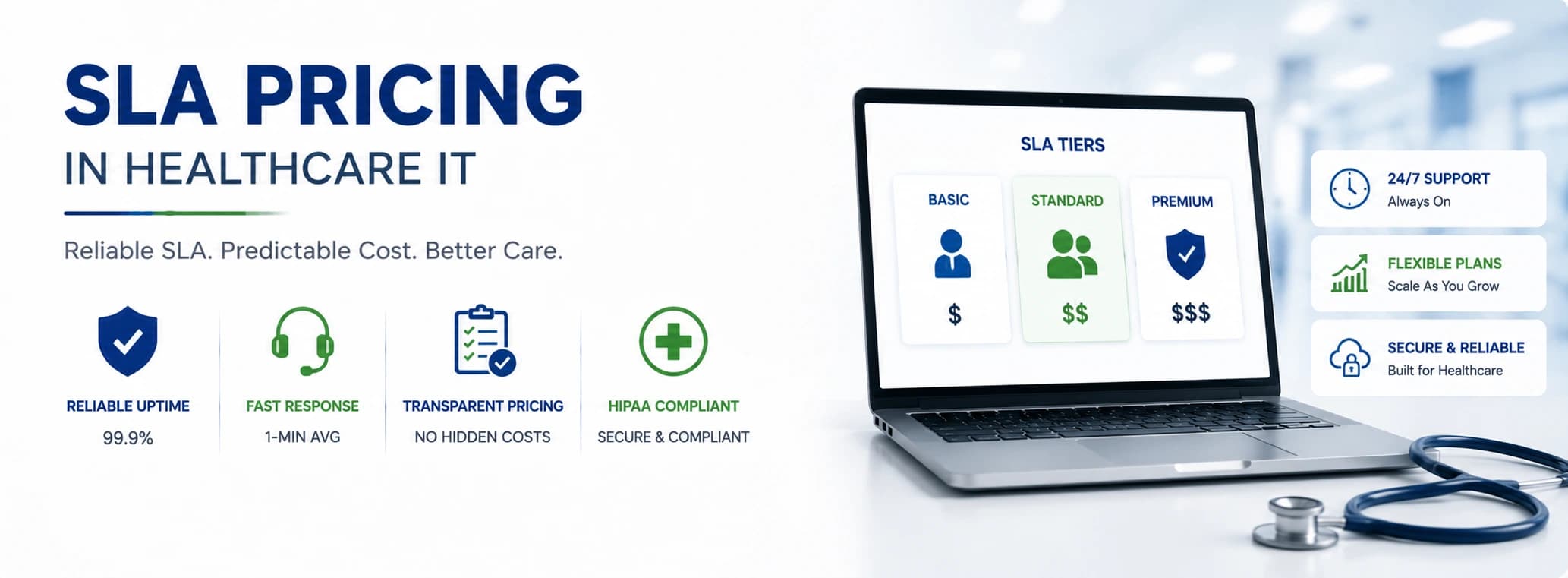
The pricing structure typically varies based on service tiers:
| SLA Tier | Coverage Model | Typical Cost Drivers | Healthcare Use Case |
|---|---|---|---|
| Basic Tier | Business hours support | Low staffing overhead, limited monitoring | Small clinics, administrative IT systems |
| Mid Tier | Extended hours with defined SLA | Partial monitoring, moderate escalation | Multi-specialty clinics and outpatient centers |
| Premium Tier | 24/7 SLA with rapid response | Full monitoring, system redundancy, dedicated escalation teams | Hospitals, critical EHR systems, labs |
| Enterprise Tier | Custom SLA with compliance focus | Dedicated engineers, HIPAA/HITRUST alignment, tailored reporting | Multi-hospital networks, integrated healthcare systems |
In real-world healthcare IT operations, SLA pricing increases further when compliance layers such as HIPAA auditing, security monitoring, and breach response protocols are included. These are not optional add-ons—they are mandatory operational components in clinical environments.
MediSure Solution’s SLA-backed managed IT services are designed to balance cost efficiency with clinical-grade reliability
Why 24/7 SLA Coverage Is the Biggest Cost Multiplier in Healthcare IT
The most significant driver of SLA pricing in healthcare is not tooling—it is coverage time. Moving from business-hours support to 24/7/365 clinical coverage fundamentally changes staffing architecture, escalation models, and monitoring infrastructure.
Healthcare environments cannot pause system monitoring because EHR access, lab reporting, and imaging workflows operate continuously. Platforms like AthenaOne and integrated HL7/FHIR systems require always-on support layers to maintain operational continuity.
Industry SLA pricing models (including IT support authority benchmarks and Xurrent SLA frameworks) indicate that 24/7 support models require multiple engineering shifts, on-call rotations, and automated monitoring systems. This increases cost due to human coverage requirements alone, even before factoring infrastructure redundancy.
MediSure operational experience across 100+ healthcare organizations shows that organizations adopting 24/7 SLA coverage reduce downtime uncertainty but experience higher baseline cost due to continuous engineering availability. However, this is offset by reduced operational disruption risk during off-hours incidents.
For healthcare CIOs, this creates a trade-off: predictable higher cost versus unpredictable clinical downtime risk.
MediSure Solution’s 24/7 infrastructure monitoring ensures continuous SLA compliance across clinical systems
Why Compliance and Security Requirements Directly Increase SLA Pricing
HIPAA compliance is a major cost driver in SLA management pricing healthcare because it introduces mandatory operational overhead beyond basic IT support. SLA frameworks in healthcare must include audit logging, breach response protocols, encryption standards, and continuous monitoring.
In environments using systems like Epic Systems, SLA contracts must also support structured documentation of incident handling and system access logs. This ensures compliance readiness during audits and regulatory reviews.
Industry SLA research from healthcare IT governance models (including HHS-aligned compliance frameworks and IBM IT service studies) indicates that security and compliance requirements significantly increase SLA costs due to continuous monitoring, threat detection systems, and incident response readiness.
Without these layers, SLA pricing would remain lower—but healthcare environments cannot operate without them due to regulatory constraints.
For healthcare organizations, compliance is not an optional SLA feature—it is embedded into the operational cost structure of every managed IT contract.
What SLA Pricing Means for Healthcare IT Decision-Makers
For CIOs, IT Directors, and healthcare operations leaders, SLA pricing should not be interpreted as a static monthly cost—it reflects the level of operational risk mitigation being purchased. Lower-cost SLA models typically reduce coverage depth, while higher-cost models increase system resilience, uptime guarantees, and response predictability.
Hospitals and multi-site healthcare systems that invest in premium SLA tiers generally experience more stable incident resolution workflows and fewer unpredictable downtime events. MediSure’s experience across hospital environments shows that structured SLA models improve operational predictability during high-severity incidents affecting clinical systems.
As healthcare IT becomes more complex with cloud migration, telehealth expansion, and interoperability demands, SLA pricing will continue shifting toward outcome-based reliability rather than simple ticket resolution.
MediSure Experience Signal (Operational Expertise)
MediSure Solution’s editorial content is developed by practitioners with direct experience supporting hospitals, medical centers, and healthcare startups across the United States. Our insights are grounded in real operational engagements — not theoretical frameworks.
Closing: The Future of SLA Pricing in Healthcare IT
Healthcare IT environments are becoming increasingly dependent on always-on systems where downtime tolerance is approaching zero. As clinical platforms expand across cloud ecosystems, interoperability layers, and AI-enabled workflows, SLA pricing models will continue evolving toward reliability-driven structures rather than simple support billing.
Over the next 2–3 years, healthcare organizations will see greater adoption of tiered SLA frameworks where cost is directly tied to uptime guarantees, response speed, and compliance depth. This shift will make SLA management pricing healthcare not just a financial consideration but a strategic infrastructure decision.
Organizations that delay structured SLA adoption may experience lower short-term costs but higher operational risk during system failures.
MediSure Solution helps healthcare organizations optimize SLA cost structures while maintaining 24/7 operational continuity, compliance readiness, and clinically aligned IT performance.
FAQs
What does SLA management pricing include in healthcare IT?
SLA management pricing covers the cost of maintaining agreed service levels for healthcare IT systems, including uptime commitments, response and resolution times, system monitoring, and compliance-related support services.
Why do healthcare IT SLA costs vary between providers?
Pricing can differ significantly based on factors such as service availability, response time commitments, infrastructure complexity, the number of supported systems, and regulatory compliance requirements.
What is the typical cost of SLA-based healthcare IT support?
The cost of healthcare IT support with SLA coverage varies according to the scope of services, support levels, and organizational needs. More comprehensive service agreements generally require a higher investment.
Why is around-the-clock SLA support priced higher?
24/7 support requires continuous monitoring, dedicated technical resources, advanced alerting systems, and rapid escalation capabilities to address issues at any time of day or night.
Do premium SLA plans provide better system performance?
Yes. Higher-tier SLA packages often include faster response times, proactive maintenance, advanced monitoring, and enhanced redundancy measures that help improve system reliability and reduce downtime.
How do regulatory and security requirements impact SLA pricing?
Healthcare compliance standards require additional safeguards such as security monitoring, audit trails, incident documentation, and risk management processes, all of which can influence the overall cost of SLA services.
Are SLA-based IT support services suitable for small healthcare practices?
Absolutely. Many healthcare IT providers offer flexible SLA options designed to meet the needs and budgets of smaller clinics, physician groups, and specialty practices while ensuring reliable system support.