Introduction
When an Electronic Health Record (EHR) system becomes unavailable inside a hospital workflow, the impact is immediate and operational—not theoretical. Clinical documentation halts, medication orders are delayed, lab results remain inaccessible, and care coordination slows down across departments. In environments running platforms like Epic Systems or Cerner Millennium, even a short outage can ripple across entire clinical ecosystems within minutes.
This is why SLA management vs IT support has become a critical decision point for healthcare leaders. Modern healthcare IT environments increasingly rely on structured SLA frameworks that define measurable uptime guarantees, response times, escalation paths, and accountability mechanisms. Industry-aligned SLA models referenced in IT service management frameworks (including IBM ITSM and Flexential healthcare SLA standards) consistently emphasize defined service levels for mission-critical systems, often including rapid response expectations for high-severity incidents.
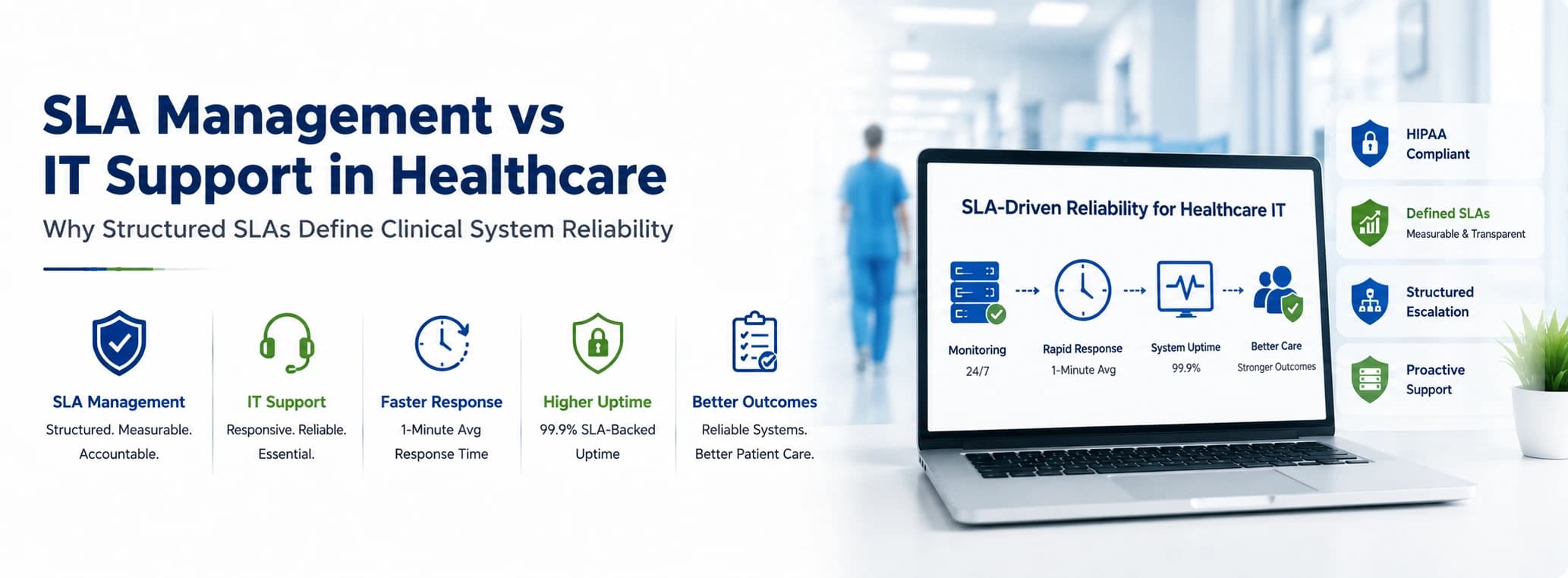
MediSure Solution currently supports 100+ healthcare organizations across hospitals, labs, and healthcare startups with 99.9% SLA-backed uptime and an average 1-minute response time for critical system incidents.
The real challenge for healthcare CIOs is no longer whether IT support exists—but whether it is predictable enough to protect clinical continuity.
SLA Management vs IT Support in Healthcare IT
| Feature | SLA Management | IT Support |
|---|---|---|
| Focus | Strategy, compliance, risk management, and vendor accountability | Incident resolution, service requests, user training, and troubleshooting |
| Scope | System-wide availability, uptime/downtime (e.g., 99.99%), disaster recovery | Tier 1–3 help desk, password resets, hardware repairs, peripheral access |
| Measurement | Quarterly reviews, service credits, penalty clauses, structural compliance | First-call resolution, response times, average handle time, user satisfaction |
| Impact | Patient safety, hospital-wide compliance (HIPAA), legal liability | Day-to-day workflow efficiency for doctors, nurses, and administrative staff |
| Key Objectives | Ensure life-critical reliability, define Recovery Time Objectives (RTO), enforce vendor accountability | Maintain operational continuity, resolve end-user issues promptly, support clinical workflows |
| Regulatory Alignment | PHI security, compliance with BAAs, HIPAA, and healthcare standards | Day-to-day adherence to hospital IT policies and procedural best practices |
| Strategic Value | Quantified system availability, legal enforceability, long-term risk mitigation | Immediate problem-solving, user satisfaction, short-term operational efficiency |
Why Healthcare IT Teams Cannot Rely on Best-Effort Support Models
Healthcare IT environments are fundamentally different from traditional enterprise IT because system downtime directly affects clinical operations. Yet many organizations still rely on standard IT support models designed for administrative environments rather than clinical infrastructure.
An IT Director managing multiple hospitals cannot manually ensure uptime across EHR systems, PACS imaging platforms, lab information systems, and network infrastructure without structured service governance. Similarly, a clinic using AthenaOne often experiences delayed resolution when issues occur outside working hours due to lack of defined escalation paths. Smaller practices using eClinicalWorks frequently struggle with backlog accumulation when IT incidents are handled reactively.
The core issue is not technical capability—it is operational predictability. Standard IT support operates on a best-effort basis, meaning resolution time depends on availability and ticket prioritization rather than clinical urgency. In healthcare environments where even seconds of downtime matter, this creates unacceptable variability in system reliability.
Structured SLA workflows solve this gap by introducing defined response tiers, escalation rules, and measurable performance thresholds.
SLA Management vs Standard IT Support: What Actually Changes in Clinical Operations
In healthcare IT environments, the difference between SLA management and standard IT support becomes most visible during system failures. SLA management is built on structured, contract-driven performance commitments, while standard IT support relies on reactive troubleshooting without guaranteed timelines.
SLA frameworks ensure that critical systems such as Epic Systems or Cerner Millennium are governed by measurable response times, uptime commitments, and escalation rules. Standard IT support, in contrast, treats incidents based on queue position and perceived severity at the time of reporting.
This difference becomes especially important in environments where HL7/FHIR-based interoperability, lab systems, and imaging platforms depend on continuous data flow. When failures occur, SLA-driven systems trigger predefined escalation workflows, while standard IT environments often begin troubleshooting only after manual prioritization.
The operational contrast can be clearly understood below:
| Dimension | SLA Management | Standard IT Support |
|---|---|---|
| Service Model | Contract-defined, fully measurable SLA framework | Reactive, best-effort support |
| Response Time | Defined targets (e.g., 1–15 minutes for critical issues) | Variable; depends on ticket queue and availability |
| System Priority | Tier-1 clinical systems (EHR, PACS, LIS) prioritized | No formal prioritization across systems |
| Uptime Guarantee | Typically 99.9% or higher | No formal uptime guarantee |
| Escalation Flow | Structured multi-tier escalation (L1 → L2 → L3) | Informal, ad-hoc escalation procedures |
| Compliance Alignment | HIPAA-aligned logging, audit-ready processes | Documentation and compliance vary by incident |
| Risk Handling | Proactive monitoring, preventive measures, and continuous oversight | Reactive troubleshooting after issues arise |
| Suitability | Hospitals, laboratories, multi-site healthcare organizations | Small clinics, office IT setups, non-critical environments |
Industry ITSM frameworks referenced by IBM and healthcare SLA studies highlight that structured SLAs reduce ambiguity during downtime events and improve accountability across service layers.
From MediSure’s operational experience across 100+ healthcare organizations, SLA environments consistently reduce downtime uncertainty and improve coordination during multi-system incidents.
MediSure Solution’s 24/7 Managed IT delivers SLA-backed clinical uptime with structured escalation and continuous monitoring.
Why a Single Server Failure Can Disrupt Entire Healthcare Workflows
In healthcare IT environments, infrastructure is deeply interconnected. A single server failure can impact multiple dependent systems simultaneously, including EHR access, lab reporting, billing systems, and imaging workflows.
When systems supporting HL7 FHIR integration fail, communication between clinical systems breaks instantly. This disrupts data exchange between laboratories, pharmacies, and clinical documentation systems.
SLA-driven environments handle this differently by defining recovery objectives (RTO/RPO), failover mechanisms, and escalation paths before failure occurs. Instead of reacting after downtime, the system is designed to respond automatically based on predefined service thresholds.
MediSure-supported healthcare environments demonstrate that structured SLA governance significantly reduces downtime impact by ensuring faster detection, immediate escalation, and predefined recovery actions. Standard IT support models, in contrast, rely heavily on manual ticket handling and delayed prioritization.
For healthcare leaders, the real risk is not infrastructure failure—it is the absence of structured recovery governance when failure happens.
MediSure Solution’s server and network management services provide SLA-based failover, monitoring, and clinical continuity assurance.
Why Compliance Risk Increases Without SLA Governance
HIPAA compliance requires healthcare organizations to maintain not only secure systems but also reliable and auditable operational processes. This includes incident tracking, system availability, and documented response procedures.
SLA management introduces structure into these requirements by defining how incidents are logged, escalated, and resolved within measurable timeframes. This becomes especially important in enterprise environments using systems like Epic Systems where patient data flows across multiple integrated modules.
Without SLA governance, compliance reporting becomes fragmented and inconsistent. During audits, organizations may struggle to demonstrate structured incident handling or consistent recovery timelines.
SLA frameworks ensure that operational behavior aligns with HIPAA expectations by embedding accountability into IT workflows rather than treating compliance as an afterthought.
What SLA Management Means for Healthcare IT Decision-Makers
For CIOs, IT Directors, and healthcare operations leaders, SLA management represents a shift from reactive IT support to predictable infrastructure governance. This shift is not about tools—it is about operational certainty.
Hospitals and multi-site healthcare systems operating under SLA-driven models experience more consistent escalation behavior, fewer undefined downtime events, and improved coordination between clinical and IT teams. MediSure’s experience across 10+ hospitals shows that SLA-based environments significantly reduce ambiguity during critical incidents.
As healthcare IT continues to evolve with cloud adoption, telemedicine expansion, and interoperability requirements, structured SLA frameworks are becoming essential for maintaining stability across increasingly complex environments.
Without SLAs, IT performance remains variable. With SLAs, IT performance becomes measurable, enforceable, and clinically aligned.
MediSure Solution helps healthcare organizations maintain operational continuity through structured SLA governance and 24/7 managed IT.
Conclusion
Healthcare IT environments are rapidly shifting toward SLA-first architecture because clinical systems can no longer tolerate unpredictable downtime. As hospitals adopt cloud-based EHR platforms, integrated lab networks, and real-time data exchange systems, operational reliability becomes a core infrastructure requirement.
Over the next few years, SLA management will move from being a contractual layer to becoming the default operating model for healthcare IT. Organizations that continue relying on best-effort IT support will face increasing operational risk as system complexity grows.
MediSure Solution helps healthcare organizations stay operational, compliant, and resilient through 24/7 managed IT services, structured SLA workflows, and clinically aligned infrastructure support.
FAQs
What is SLA management in healthcare IT?
SLA (Service Level Agreement) management is a structured approach to IT support that defines performance standards such as system uptime, response times, issue resolution targets, and escalation procedures for critical healthcare applications, including EHRs, laboratory systems, and medical imaging platforms.
How does SLA management differ from traditional IT support?
Unlike traditional IT support, which often operates on a reactive basis, SLA management establishes clear service expectations, measurable performance metrics, and predefined escalation processes to ensure consistent and reliable support.
Why are Service Level Agreements important for healthcare organizations?
Healthcare providers rely on uninterrupted access to clinical and administrative systems. SLAs help minimize downtime, improve service reliability, and ensure that critical incidents are addressed according to their urgency and impact on patient care.
Can SLA management support healthcare compliance requirements?
Yes. Effective SLA management promotes detailed incident tracking, documented response procedures, and audit-ready reporting, helping healthcare organizations maintain compliance with regulatory and security standards.
Which healthcare systems should be covered by an SLA?
Organizations should establish SLA coverage for mission-critical systems such as Electronic Health Records (EHRs), PACS imaging platforms, HL7 integration engines, laboratory information systems, revenue cycle applications, and patient management solutions.
Is SLA-based IT support beneficial for smaller clinics and medical practices?
Absolutely. Even smaller healthcare facilities depend heavily on digital systems for patient scheduling, record access, billing, and communication. SLA-backed support helps ensure operational continuity and reduces disruptions.
What happens when SLA commitments are not achieved?
If agreed service levels are missed, the SLA typically outlines escalation protocols, corrective actions, performance reviews, and, in some cases, service credits or contractual penalties based on the severity of the issue.