When a legacy system migration fails in a healthcare environment, the cost is not measured in dollars alone. Critical patient records may become inaccessible, clinical workflows can slow down, integrations may break unexpectedly, and IT teams are forced into crisis management instead of strategic modernization.
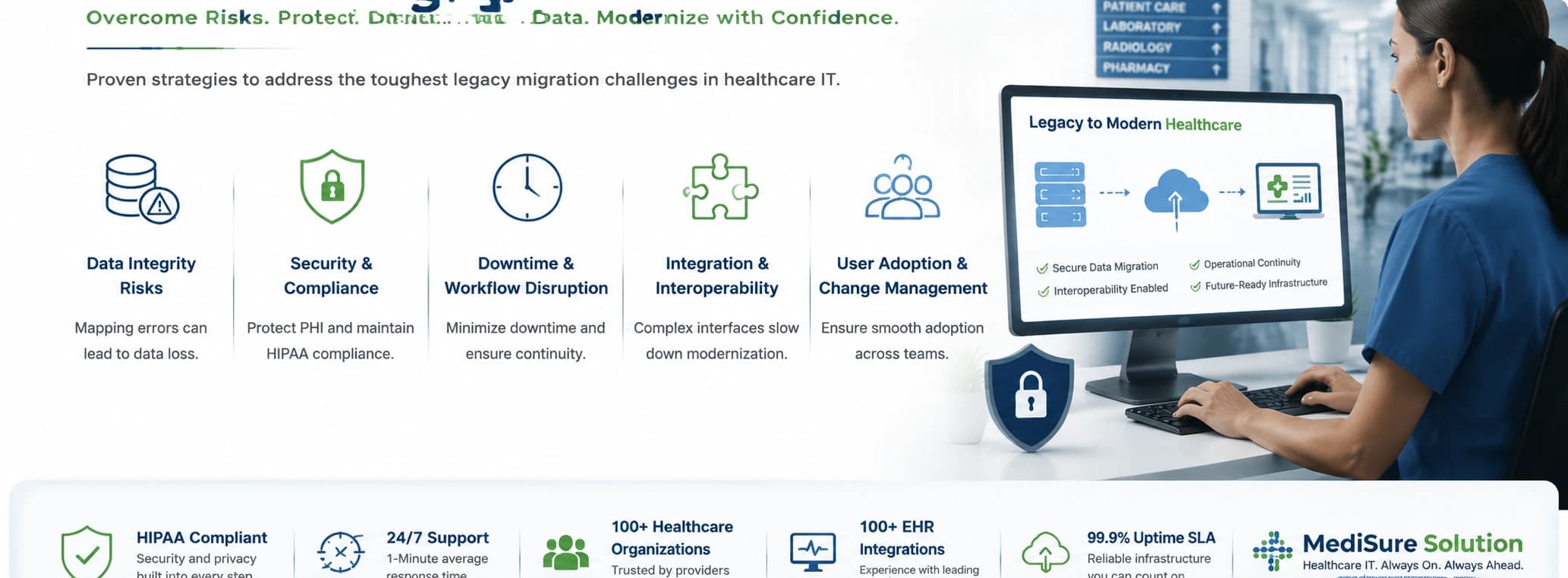
Industry estimates suggest that healthcare organizations continue to face significant obstacles when moving data and workflows from legacy platforms to modern systems. Common concerns include data integrity issues, compliance exposure, workflow disruption, and interoperability failures during migration projects (Olah, a Verisma Company; Access Information Management). At the same time, healthcare leaders are under increasing pressure to modernize aging EHRs, laboratory systems, PACS environments, and administrative applications while maintaining HIPAA compliance and operational continuity.
These realities make understanding the most critical legacy migration challenges healthcare organizations encounter essential before any modernization initiative begins. The organizations that achieve successful migrations are rarely the ones with the newest technology—they are the ones that proactively address migration risks before they impact operations.
Common Legacy Migration Challenges & Solutions in Healthcare IT
| Challenge Area | Core Problem | Proven Solution | Healthcare IT Impact |
|---|---|---|---|
| Data Integrity & Mapping | Legacy systems use proprietary formats causing duplicate, missing, or inconsistent records | Data cleansing, automated mapping, validation, and semantic interoperability alignment (HL7 FHIR, HL7 v2.x, CDA) | Ensures accurate patient records, reduces clinical errors, and preserves data usability after migration |
| Security & Compliance Risks | PHI exposure risk increases during data transfer and hybrid system operation | Encryption (at rest & in transit), role-based access control, audit logging, HIPAA-aligned governance | Prevents breaches and ensures regulatory compliance throughout migration lifecycle |
| Workflow Disruption & Downtime | Healthcare systems operate 24/7, making downtime highly disruptive | Phased migration, parallel system run, failover planning, downtime scheduling | Maintains continuity of clinical operations and reduces patient care disruption |
| Cost Overruns & Project Delays | Unclear scope, vendor dependency, and legacy complexity increase budget risk | Early discovery, stakeholder alignment, structured migration planning, expert consultation | Improves cost predictability and reduces migration execution risks |
| Historical Data Archiving | Migrating all legacy data slows performance and increases cost | Active/passive archival with secure, searchable repositories | Reduces system load while preserving long-term access to patient history |
| Interoperability Failures | Legacy systems lack modern API and FHIR compatibility | Middleware, API integration, HL7 FHIR adoption, interface engine testing | Enables seamless data exchange between EHR, LIS, PACS, and external systems |
Why Healthcare Organizations Are Struggling With Legacy Migration Complexity
Healthcare organizations depend on interconnected ecosystems of EHRs, laboratory information systems, PACS archives, billing applications, scheduling platforms, and third-party integrations. Modernizing one component often affects dozens of downstream systems.
An IT Director managing multiple hospital locations cannot simply replace an aging platform without evaluating interface dependencies, data retention requirements, and integration workflows. A Clinical Informatics Manager overseeing interoperability projects may encounter legacy systems that store information in proprietary formats incompatible with modern standards. A clinic operating eClinicalWorks alongside older departmental applications may face significant challenges balancing testing validation requirements with aggressive migration timelines.
The complexity grows further when organizations attempt to address integration pitfalls while minimizing operational disruption. Clinical teams expect continuous access to information, but many healthcare environments still rely on legacy applications that were never designed to support modern interoperability requirements. This creates a persistent gap between what healthcare organizations need and what aging systems can reliably deliver.
Why Data Mapping Errors Create the Highest Data Loss Risk During Migration
Many healthcare migration failures originate long before deployment. They begin during data extraction, transformation, and mapping activities.
Legacy healthcare systems frequently contain decades of structured and unstructured information, including clinical notes, CDA documents, HL7 v2.x messages, DICOM references, billing records, and custom data fields. When information stored in proprietary formats is migrated into modern EHR platforms such as Cerner, Athenahealth, or eClinicalWorks, mapping inconsistencies can compromise accessibility and usability.
Industry guidance consistently identifies data complexity and proprietary storage formats as major contributors to migration-related integrity issues (Access Information Management; TierPoint). Automated cleansing, normalization, and validation processes are increasingly viewed as essential safeguards against data loss risk during healthcare modernization initiatives.
MediSure Solution’s experience supporting more than 100 healthcare organizations and over 100 EHR integrations reinforces this reality. Successful migration projects prioritize source-system analysis, data reconciliation, and validation testing long before production cutovers occur.
What this means for Healthcare CIOs and Clinical Informatics leaders is that migration planning should focus as much on data quality as on infrastructure modernization. A modern platform cannot deliver value if critical information arrives incomplete or improperly mapped.
MediSure Solution’s Legacy Migration services help healthcare organizations preserve data integrity through structured extraction, validation, and migration methodologies designed for complex healthcare environments.
Why Security and Compliance Risks Often Increase During Migration Projects
Many healthcare organizations focus on security vulnerabilities within legacy systems but underestimate the additional risks introduced during migration activities.
Migration projects often create temporary hybrid environments where legacy and modern systems operate simultaneously. During this period, data moves between repositories, interfaces are modified, and user access patterns change. Without proper controls, organizations can inadvertently create new security exposures while attempting to eliminate existing ones.
Industry assessments indicate that aging healthcare systems frequently lack modern encryption standards, advanced identity controls, and comprehensive audit capabilities required to support HIPAA-aligned operations (Stromasys; Ralabs). Modern migration strategies increasingly incorporate encryption at rest and in transit, continuous audit logging, role-based access management, and risk assessments throughout the migration lifecycle.
MediSure Solution supports HIPAA compliance across all service offerings and applies healthcare-focused security practices during modernization initiatives. Combined with a 99.9% uptime SLA and a one-minute average response time, these operational controls help organizations maintain resilience while transitioning critical systems.
What this means for Directors of IT Operations and healthcare executives is that migration should never be treated as a standalone technology project. Security architecture, compliance controls, and governance processes must evolve alongside infrastructure modernization.
Healthcare organizations planning modernization initiatives should ensure security and compliance requirements are embedded into every migration phase rather than addressed after deployment.
Why Downtime Mitigation Requires More Than a Cutover Plan
Many migration strategies focus heavily on deployment activities while giving insufficient attention to continuity planning. In healthcare environments, this can create significant operational challenges.
Clinical documentation, laboratory workflows, scheduling systems, and administrative processes often operate continuously. Even short disruptions can affect workflow efficiency and increase pressure on support teams. Migration projects that rely exclusively on single-event cutovers frequently underestimate the complexity of maintaining continuity across interconnected applications.
Industry guidance increasingly recommends phased deployment models, data archiving strategies, and staged transition approaches to support downtime mitigation efforts (Olah, a Verisma Company; Access Information Management). Maintaining access to historical records through secure archival solutions can also reduce migration scope and lower operational risk.
MediSure Solution has observed that healthcare organizations often achieve smoother transitions when migration planning incorporates failover procedures, rollback capabilities, defined RTO and RPO objectives, and comprehensive validation checkpoints. These safeguards provide flexibility when unexpected issues arise during deployment.
What this means for Practice Managers, Lab IT Coordinators, and hospital technology leaders is that continuity planning should be treated as a core migration requirement—not an optional project enhancement.
MediSure Solution helps healthcare organizations implement migration strategies designed to maintain operational continuity while reducing disruption to critical healthcare workflows.
Why Interoperability Failures Continue to Delay Modernization Efforts
Many modernization initiatives reach advanced stages before organizations discover that essential integrations do not function as expected within the new environment.
Healthcare ecosystems depend on seamless communication between EHRs, pharmacies, laboratories, imaging systems, revenue-cycle applications, and external provider networks. Legacy systems frequently lack the flexibility required to support modern API architectures, creating significant integration pitfalls during migration projects.
Industry experts increasingly recommend adopting interoperability standards such as HL7 FHIR and HL7 v2.x to improve compatibility between legacy and modern systems (Aditya Goswami; Medical ITG). Middleware platforms and interface engines also play an important role in bridging older applications with contemporary healthcare technology stacks.
MediSure Solution’s experience supporting hospitals, laboratories, clinics, and healthcare startups demonstrates that integration testing often determines migration success more than infrastructure deployment itself. Organizations that validate interfaces early and repeatedly typically experience fewer disruptions during go-live activities.
What this means for Clinical Informatics Managers and Healthcare CIOs is that interoperability testing should begin at the start of a migration project—not after implementation decisions have already been finalized.
Healthcare organizations can reduce migration risk by aligning modernization efforts with proven interoperability standards and healthcare-specific integration strategies.
MediSure Solution’s editorial content is developed by practitioners with direct experience supporting hospitals, medical centers, laboratories, and healthcare startups across the United States. Our insights are grounded in real operational engagements involving EHR migrations, interoperability projects, healthcare infrastructure modernization, and compliance-focused IT operations—not theoretical frameworks.
Conclusion
Healthcare IT environments are under more pressure than ever before. Aging systems continue to create operational constraints while cybersecurity expectations, interoperability requirements, and regulatory obligations continue to increase.
Over the next several years, healthcare organizations will continue accelerating modernization initiatives focused on interoperability, cloud adoption, data accessibility, and security resilience. However, the organizations that achieve the best outcomes will not necessarily be the fastest movers. They will be the ones that proactively address data integrity concerns, compliance risks, workflow disruptions, and integration challenges before migration begins.
At MediSure Solution, we have seen firsthand how successful healthcare migrations depend on preparation, governance, validation, and operational support. We help hospitals, clinics, laboratories, healthcare startups, and pharmaceutical organizations navigate complex migration projects while maintaining uptime, security, and workflow continuity. Whether the goal is retiring a legacy EHR, modernizing infrastructure, or improving interoperability, we help healthcare organizations move forward with confidence.
MediSure Solution helps healthcare organizations stay operational, compliant, and ahead of downtime get expert healthcare IT support at https://medisuresolution.com.
Frequently Asked Questions
What are the most common legacy migration challenges in healthcare?
The most common challenges include data integrity issues, security vulnerabilities, HIPAA compliance concerns, interoperability failures, workflow disruptions, staff adoption challenges, and downtime risks during migration activities.
Why is data loss a concern during healthcare migrations?
Healthcare systems often contain decades of information stored in proprietary formats. Poor mapping, transformation errors, and inadequate validation processes can result in missing, corrupted, or inaccessible records after migration.
How can healthcare organizations reduce downtime during migration?
Organizations can reduce downtime through phased migration approaches, archival strategies, failover planning, rollback procedures, comprehensive testing, and clearly defined RTO and RPO objectives.
What role does HIPAA play in legacy migration projects?
HIPAA influences how Protected Health Information is accessed, transferred, stored, and audited throughout the migration lifecycle. Security controls and governance procedures must be maintained during every project phase.
Why do interoperability issues occur during healthcare modernization?
Legacy systems often lack support for modern APIs and interoperability standards. This creates challenges when integrating EHRs, laboratories, pharmacies, imaging systems, and third-party applications.
How important is testing validation during migration?
Testing validation is critical. It helps identify mapping errors, interface failures, workflow disruptions, and performance issues before production deployment, reducing operational risk.
What standards support healthcare interoperability during migration?
Common standards include HL7 FHIR, HL7 v2.x, CDA, and DICOM. These standards help improve data exchange and integration between healthcare applications.
Should healthcare organizations archive legacy data instead of migrating everything?
In some cases, archival strategies can reduce migration complexity. Historical records can remain accessible in secure repositories while active data is migrated to modern systems.
What should healthcare leaders look for in a migration partner?
Organizations should prioritize healthcare-specific expertise, HIPAA-focused processes, interoperability experience, structured validation methodologies, post-migration support capabilities, and proven healthcare IT experience.
How does MediSure Solution support healthcare migration initiatives?
MediSure Solution provides healthcare-focused Legacy Migration, EHR Support, Network Management, Server Management, and 24/7 Managed IT services. Our team supports more than 100 healthcare organizations, delivers a 99.9% uptime SLA, maintains a one-minute average response time, and supports HIPAA compliance across all services.