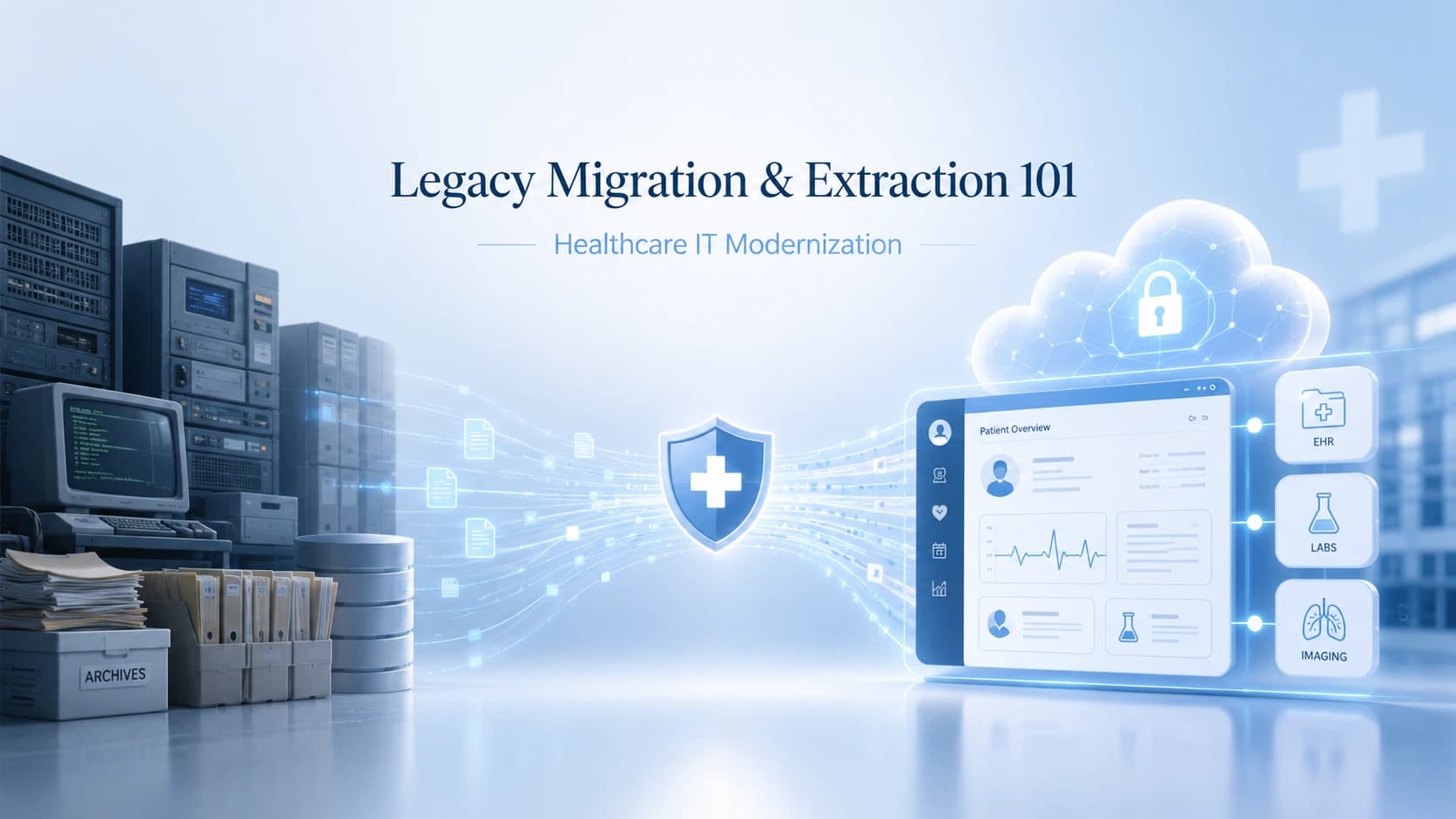
When a healthcare system fails, the cost is not measured in dollars alone. Delayed access to historical records, incomplete patient histories, and operational disruptions can impact every department—from registration and billing to clinical documentation and compliance reporting.
As healthcare organizations modernize EHR platforms, retire aging infrastructure, and consolidate data across multiple locations, legacy migration and extraction healthcare projects have become a critical operational priority. Industry estimates suggest that duplicate patient records can account for approximately 8–12% of healthcare databases, creating significant challenges during modernization initiatives. At the same time, many providers continue operating unsupported legacy applications that increase cybersecurity exposure, maintenance costs, and interoperability barriers.
The challenge is not simply moving data from one system to another. Healthcare organizations must preserve historical records, maintain HIPAA compliance, support clinical workflows, and ensure continuity of operations throughout the transition. This guide explains what legacy migration and extraction means in healthcare IT, why it matters, and how organizations can modernize without compromising access to critical information.
Why Healthcare Organizations Are Struggling With Legacy System Modernization
Healthcare leaders are being asked to deliver interoperability, security, and operational efficiency while still supporting systems that were never designed for today’s digital healthcare environment.
An IT Director managing five hospital locations cannot easily maintain aging EHR databases, legacy PACS environments, and disconnected departmental applications while simultaneously supporting new initiatives. A Clinical Informatics Manager overseeing data normalization across multiple platforms may struggle with inconsistent record structures and fragmented patient histories. A clinic operating eClinicalWorks without dedicated migration expertise often faces difficult decisions about what data should be transferred, archived, or retired.
The challenge extends beyond technology. Legacy system modernization requires balancing compliance obligations, operational continuity, and budget constraints. Historical data often exists in proprietary formats, unsupported databases, or applications that no longer integrate effectively with modern healthcare ecosystems.
As organizations pursue healthcare IT upgrades, data migration projects frequently become larger and more complex than initially anticipated. Without a structured strategy for application extraction, data mapping, validation, and archiving, modernization efforts can introduce unnecessary operational risk and long-term technical debt.
Legacy Data Extraction Is About More Than Moving Records
Many healthcare organizations view migration as a simple transfer process. In reality, extraction is often the most technically demanding phase of the project.
Legacy healthcare applications frequently contain structured data such as demographics, medications, allergies, laboratory results, and billing records alongside unstructured content including scanned documents, PDFs, physician notes, and imaging references. Extracting this information requires a comprehensive understanding of database architecture, data relationships, and retention requirements. Systems such as Cerner, Athenahealth, eClinicalWorks, MEDITECH, and proprietary departmental applications often store information differently, creating substantial complexity during modernization efforts.
Industry guidance from healthcare migration specialists indicates that successful projects begin with a detailed assessment and extraction phase that inventories all available data sources before any migration occurs. Historical records must be identified, classified, and securely extracted while maintaining HIPAA compliance and auditability throughout the process.
For Healthcare CIOs and IT Operations Directors, this means migration planning cannot begin at the destination system. It must begin with a complete understanding of the source environment, including databases, integrations, interfaces, storage dependencies, and retention obligations.
MediSure Solution’s Legacy Migration services help healthcare organizations securely extract and preserve critical information from aging systems while maintaining operational continuity throughout modernization initiatives.
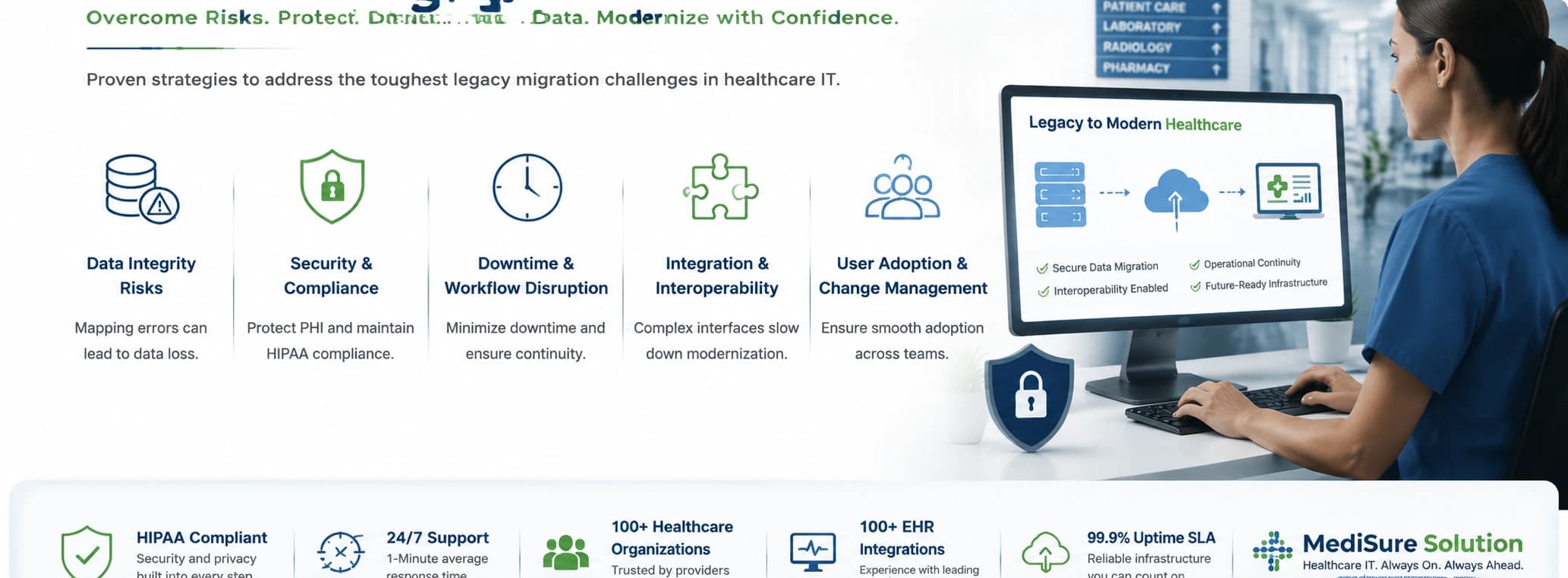
Data Mapping Failures Create Long-Term Operational Risk
The most expensive migration problems often appear after go-live rather than during the migration itself.
Legacy systems frequently contain inconsistent data structures accumulated over years of operational changes. Patient demographics may be stored differently across applications. Clinical documentation formats may vary by department. Historical interfaces built on HL7 v2.x may not align directly with modern HL7 FHIR architectures. DICOM imaging references and CDA documents can introduce additional complexity when moving data into new environments.
Industry estimates suggest duplicate record rates in healthcare databases can reach 8–12%, making data cleansing and normalization a critical component of migration planning. Improper mapping can lead to incomplete historical records, reporting inaccuracies, and workflow inefficiencies that persist long after the project is completed.
Organizations with mature migration strategies typically perform extensive transformation and validation activities before loading data into production environments. This includes cleansing duplicate records, standardizing formats, validating relationships, and testing interoperability requirements within controlled environments.
For Clinical Informatics Managers and Healthcare Startup CTOs, data quality should be considered a strategic objective rather than a technical afterthought. Accurate mapping ensures historical context remains accessible and usable within modern clinical and operational workflows.
MediSure Solution supports healthcare data migration projects with structured validation methodologies designed to protect data integrity across EHR transitions and healthcare IT upgrades.
Why Healthcare Organizations Are Choosing Hybrid Migration Strategies
Not every record belongs inside a new EHR platform.
One of the most common misconceptions in healthcare modernization is that all historical information must be migrated directly into the replacement system. In reality, many organizations adopt a hybrid approach that balances accessibility, cost, and operational efficiency.
Industry migration guidance indicates that many providers migrate only the most recent one to two years of actively used clinical data into their new EHR while securely archiving older records in searchable read-only repositories. This strategy allows clinicians to access current information within their primary workflow while maintaining compliant access to historical records when needed.
Active archiving also helps eliminate ongoing expenses associated with maintaining unsupported servers, software licenses, and specialized legacy infrastructure. Organizations can retire aging applications while continuing to satisfy HIPAA and applicable record-retention requirements.
For Practice Managers, Hospital Administrators, and Lab IT Coordinators, the hybrid model often reduces project complexity while preserving access to historical data. It provides a practical balance between modernization goals and operational realities.
MediSure Solution helps healthcare organizations evaluate whether full migration, active archiving, or a hybrid strategy best aligns with their operational, compliance, and budget requirements.
Validation and Phased Rollouts Reduce Clinical Disruption
Successful healthcare migrations are measured by continuity, not speed.
Large-scale healthcare environments cannot afford unexpected downtime during major platform transitions. Clinical workflows, laboratory operations, billing systems, and provider documentation processes depend on uninterrupted access to accurate information.
Industry best practices recommend validation through sandbox testing environments before production deployment. Many organizations utilize Change Data Capture (CDC) methodologies to verify integrity, consistency, and completeness prior to go-live. Rather than migrating all systems simultaneously, phased rollout approaches help reduce operational risk by introducing changes incrementally and allowing teams to address issues before broader deployment.
This approach aligns with MediSure Solution’s operational philosophy. Supporting more than 100 healthcare organizations and over 10 hospitals, the team understands that healthcare technology projects must prioritize stability, predictable recovery objectives, and workflow continuity. Combined with a 99.9% uptime SLA and a one-minute average response time, operational resilience remains central to every infrastructure and migration engagement.
For Healthcare CIOs and IT Directors, validation is not simply a project milestone. It is the mechanism that protects operational continuity, preserves trust across departments, and minimizes disruption during transformation initiatives.
MediSure Solution delivers healthcare-focused migration planning and support backed by proven operational processes designed for complex clinical environments.
MediSure Solution’s editorial content is developed by practitioners with direct experience supporting hospitals, medical centers, laboratories, and healthcare startups across the United States. Our insights are grounded in real operational engagements involving healthcare infrastructure, EHR support, compliance-driven modernization initiatives, and legacy system transitions—not theoretical frameworks.
FAQs
1. What is legacy migration and extraction in healthcare?
Legacy migration and extraction in healthcare is the process of securely retrieving patient, clinical, financial, and operational data from outdated healthcare systems and transferring or archiving it for use in modern platforms while maintaining compliance and data integrity.
2. Why is legacy data migration important for healthcare organizations?
Legacy data migration helps healthcare organizations improve interoperability, reduce cybersecurity risks, lower maintenance costs, support EHR modernization, and ensure continued access to historical patient records.
3. What are the biggest challenges in healthcare legacy system migration?
Common challenges include data quality issues, duplicate patient records, incompatible data formats, regulatory compliance requirements, system downtime risks, and maintaining access to historical information during migration.
4. How do healthcare organizations ensure HIPAA compliance during data migration?
Organizations maintain HIPAA compliance through encrypted data transfers, access controls, audit trails, secure extraction processes, data validation procedures, and adherence to healthcare data retention policies.
5. What is the difference between data migration and data archiving in healthcare?
Data migration moves information into a new healthcare system, while data archiving stores historical records in a secure, searchable repository for future access without loading all data into the new platform.
6. Should all historical patient data be migrated to a new EHR?
Not always. Many healthcare organizations use a hybrid approach by migrating active clinical data while archiving older records to reduce costs, simplify implementation, and maintain compliance.
7. How long does a healthcare legacy migration project take?
Project timelines vary depending on the size of the organization, number of systems involved, data quality, and compliance requirements. Small projects may take a few months, while enterprise migrations can take a year or longer.
8. What healthcare systems can be migrated or extracted?
Data can be extracted from and migrated between systems such as Cerner, MEDITECH, Athenahealth, eClinicalWorks, Allscripts, legacy PACS platforms, laboratory systems, billing applications, and custom healthcare databases.
Conclusion
Healthcare IT environments are under more pressure than ever before. Organizations must modernize aging systems, improve interoperability, strengthen cybersecurity defenses, and support growing data volumes while maintaining uninterrupted access to critical information.
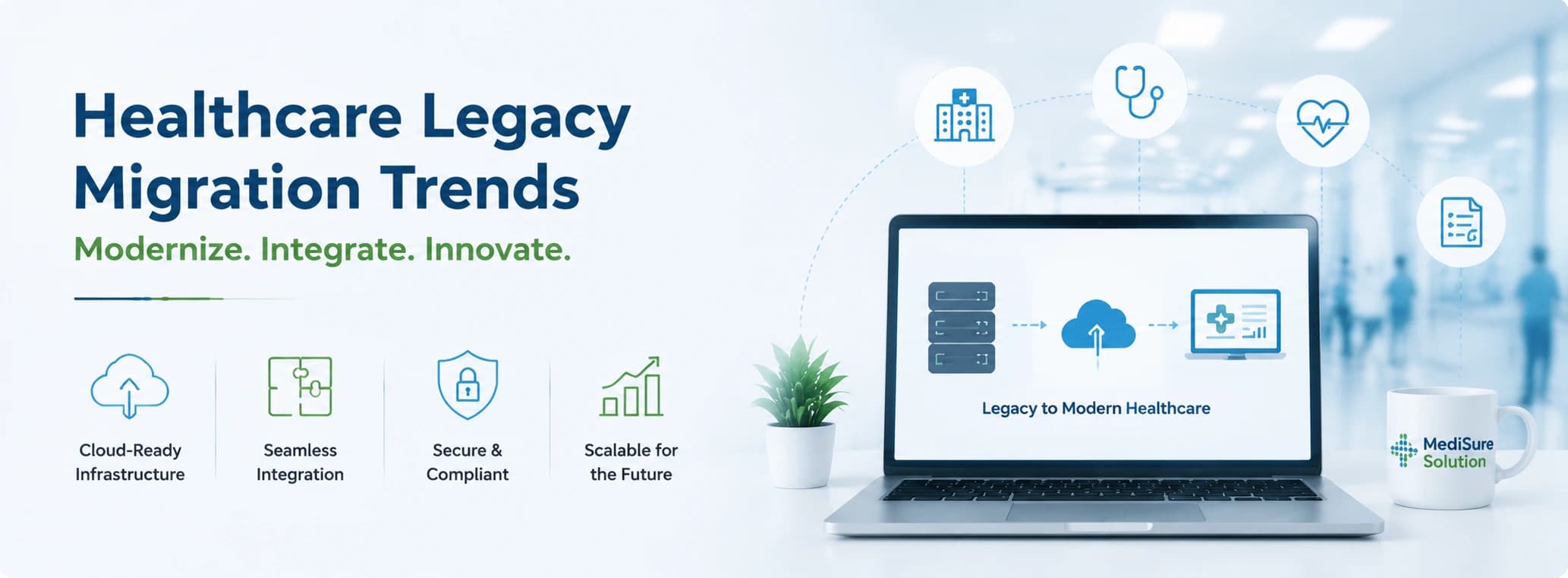
Over the next several years, healthcare modernization efforts will increasingly center around interoperability frameworks such as HL7 FHIR, cloud-enabled infrastructure, advanced analytics, and streamlined clinical workflows. Organizations that continue relying on unsupported legacy applications will face rising operational costs, growing security exposure, and increasing challenges integrating with modern healthcare ecosystems.
The organizations that succeed will be those that treat legacy migration and extraction as a strategic initiative rather than a technical project. Careful planning, structured validation, compliant archiving, and operationally focused execution will define successful modernization programs.
At MediSure Solution, we help hospitals, clinics, laboratories, healthcare startups, and healthcare enterprises stay operational, compliant, and prepared for the future. Whether your organization is planning an EHR transition, consolidating systems after an acquisition, or retiring aging infrastructure, we provide the expertise needed to execute migrations with confidence. Visit MedisureSolution.com to learn how our Legacy Migration services can support your next healthcare IT modernization initiative.