When patient intake fails in a healthcare environment, the cost is not measured in dollars alone. Delayed registrations, incomplete demographic records, insurance verification errors, and disconnected scheduling systems can create operational bottlenecks that ripple across every department.
As healthcare organizations expand into satellite clinics, ambulatory centers, remote care programs, and specialty practices, the complexity of managing intake across multiple locations grows exponentially. Industry estimates suggest that centralized intake models, AI-assisted registration workflows, and integrated patient engagement platforms can significantly reduce administrative friction while improving operational consistency across care networks (HIMSS, Becker’s Healthcare).
This is why multi-site patient intake support has become a strategic priority for hospital IT leaders, clinical informatics teams, and healthcare executives. Modern healthcare organizations are moving beyond isolated registration processes toward centralized intake, distributed workflow orchestration, and real-time operational visibility.
The challenge is no longer simply collecting patient information. The challenge is ensuring every location, system, and stakeholder operates from the same source of truth while maintaining HIPAA compliance, interoperability, and operational continuity.
Why Healthcare Organizations Are Struggling With Multi-Site Intake Complexity
Healthcare leaders are being asked to support larger patient populations across increasingly distributed care environments. Yet many organizations still rely on fragmented intake workflows that were designed for a single facility rather than an enterprise-wide network.
An IT Director managing five hospital locations cannot efficiently standardize registration procedures when each site uses different intake processes, scheduling rules, and data collection methods. A Clinical Informatics Manager supporting multiple outpatient facilities may find that demographic updates entered at one location do not flow consistently across connected systems. A clinic running eClinicalWorks without dedicated integration support often struggles to maintain synchronized workflows between scheduling, registration, and billing functions.
The rise of remote clinic enrollment has introduced additional complexity. Patients now expect to complete forms on mobile devices, upload documentation remotely, and interact with providers through digital channels before arriving for appointments.
Without centralized intake infrastructure, healthcare organizations often face inconsistent data quality, distributed workflow inefficiencies, and limited visibility into enterprise-wide patient flow. As healthcare delivery models continue expanding beyond traditional hospital campuses, these operational gaps become increasingly difficult to manage using manual processes alone.
Why Centralized Intake Has Become the Operational Backbone of Multi-Site Healthcare
The most successful healthcare networks are treating patient intake as an enterprise function rather than a facility-specific task.
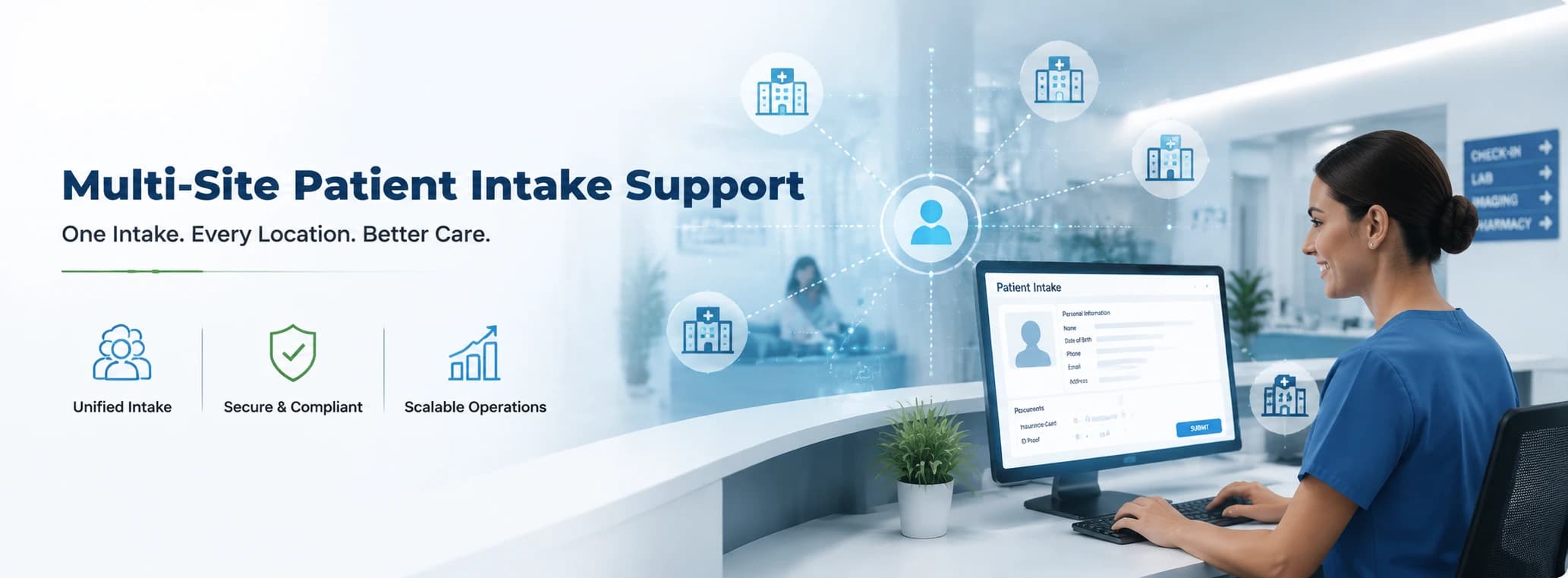
Centralized intake creates a unified front door for patient access across all care locations. By integrating scheduling, insurance verification, demographic collection, consent management, and pre-registration workflows into a single framework, organizations can standardize processes regardless of whether a patient visits a hospital, specialty clinic, laboratory, or telehealth service.
Modern platforms such as AdvancedMD, Phreesia, and other healthcare intake solutions enable patient data collection before arrival while synchronizing information directly with EHR environments. When integrated through HL7 FHIR, HL7 v2.x, CDA, and other interoperability standards, intake data can move seamlessly across clinical and administrative systems.
MediSure Solution has supported more than 100 healthcare organizations while maintaining HIPAA-focused operational practices and supporting over 100 EHR integrations. This firsthand experience consistently demonstrates that healthcare organizations achieve greater workflow consistency when intake operations are standardized across all locations.
What this means for Healthcare CIOs and IT Directors is straightforward: intake standardization is no longer a registration initiative. It is an enterprise data governance strategy that affects scheduling accuracy, revenue cycle performance, interoperability, and operational scalability.
Organizations seeking stronger healthcare infrastructure resilience can align centralized intake initiatives with MediSure Solution’s EHR Support services to maintain workflow continuity across complex care environments.
Multi-Site Intake Technology Framework
| Capability | Operational Value |
|---|---|
| Centralized Intake | Standardizes registration, scheduling, and verification across all sites |
| Remote Clinic Enrollment | Enables secure onboarding from home or remote locations |
| Distributed Workflow | Eliminates departmental information silos |
| AI Automation | Reduces repetitive administrative workload |
| Real-Time Monitoring | Improves operational visibility and patient flow management |
| Predictive Workflows | Anticipates bottlenecks and resource demands |
Distributed Workflows Eliminate the Hidden Cost of Information Silos
Many healthcare organizations focus on intake technology while overlooking the workflow architecture behind it.
A patient may complete digital registration successfully, but operational inefficiencies still emerge when referrals, lab orders, imaging requests, and follow-up tasks are manually transferred between departments. This creates delays that are difficult to detect and even harder to resolve across multiple facilities.
Distributed workflow environments use cloud-connected systems to route information automatically between departments, providers, laboratories, and external partners. Through interoperability frameworks and real-time data exchange, organizations can ensure that registration events trigger downstream processes without requiring manual intervention.
Enterprise healthcare environments increasingly rely on integrations between Cerner, Athenahealth, eClinicalWorks, PACS environments, laboratory systems, and revenue cycle platforms. When these systems operate independently, patient intake becomes disconnected from the broader care delivery process.
MediSure Solution’s experience supporting hospitals, clinics, laboratories, and healthcare startups highlights a recurring pattern: organizations that prioritize workflow orchestration experience fewer operational disruptions than those focused solely on front-end registration technologies.
What this means for Directors of IT Operations is that intake modernization should be evaluated through the lens of end-to-end workflow continuity rather than registration efficiency alone.
Healthcare organizations seeking enterprise-wide workflow reliability often complement intake modernization with MediSure Solution’s Network Management services to maintain secure, uninterrupted connectivity across locations.
AI Automation Is Reshaping Intake Operations Without Expanding Administrative Headcount
Administrative workloads continue increasing while healthcare organizations face persistent staffing pressures.
AI automation is emerging as a practical solution for high-volume intake activities such as appointment scheduling, insurance verification, demographic collection, fax triage, and patient communication management. Conversational AI agents can collect information before appointments, reducing the burden on registration staff while maintaining consistent workflows across all facilities.
Platforms supporting virtual assistants and AI-enabled intake workflows are increasingly being deployed alongside EHR systems to streamline front-office operations. These technologies are particularly valuable for organizations managing remote clinic enrollment programs and geographically distributed patient populations.
Industry estimates suggest that healthcare organizations are increasingly investing in AI-driven operational automation to address workforce shortages and improve administrative efficiency (HIMSS, Becker’s Healthcare). However, success depends heavily on integration quality, governance controls, and infrastructure reliability.
MediSure Solution’s operational experience includes supporting healthcare environments with a 99.9% uptime SLA and a one-minute average response time. For organizations deploying AI-enabled intake systems, infrastructure reliability becomes critical because automation platforms cannot deliver value during network disruptions or application downtime.
What this means for Clinical Informatics Managers and Healthcare Startup CTOs is that AI initiatives should be evaluated alongside infrastructure readiness, interoperability requirements, and operational support models.
AI-enabled intake workflows perform best when supported by proactive healthcare IT operations and around-the-clock monitoring from experienced managed service providers.
Real-Time Monitoring and Predictive Workflows Turn Intake Into a Strategic Asset
Traditional patient intake models provide visibility into what already happened. Modern healthcare organizations need visibility into what is likely to happen next.
Real-time monitoring platforms allow organizations to track patient flow, registration volumes, scheduling demand, operational throughput, and resource utilization across multiple locations simultaneously. Command-center models and enterprise dashboards help healthcare leaders identify bottlenecks before they impact service delivery.
Predictive workflows extend these capabilities further by analyzing historical and real-time operational data to forecast demand patterns, staffing requirements, scheduling constraints, and resource allocation needs.
Healthcare organizations adopting predictive operational models are increasingly combining intake analytics, EHR data, and enterprise monitoring tools to improve decision-making across care networks. These capabilities become especially important when managing multiple hospitals, outpatient clinics, laboratories, and telehealth programs.
MediSure Solution currently supports more than 10 hospitals and over 100 healthcare organizations nationwide. Across these environments, operational visibility consistently emerges as one of the strongest predictors of infrastructure stability and service continuity.
What this means for Healthcare CIOs is that intake modernization should not end with digital registration. The long-term value comes from creating an intelligence layer that transforms patient access data into actionable operational insights.
Organizations implementing predictive healthcare operations often strengthen outcomes by aligning intake systems with proactive Server Management and 24/7 infrastructure monitoring capabilities.
MediSure Solution’s editorial content is developed by practitioners with direct experience supporting hospitals, medical centers, laboratories, and healthcare startups across the United States. Our insights are grounded in real operational engagements supporting HIPAA-sensitive environments, EHR ecosystems, interoperability initiatives, and enterprise healthcare infrastructure—not theoretical frameworks.
The Future of Multi-Site Patient Intake Is Connected, Automated, and Predictive
Healthcare IT environments are under more pressure than ever before. Expanding care networks, workforce constraints, growing patient expectations, and increasing compliance requirements are forcing organizations to rethink how patient access operations are managed.
Over the next several years, healthcare organizations will continue moving toward AI-enabled intake automation, centralized operational command centers, predictive workflow engines, and highly interoperable digital ecosystems. The organizations that act now will be better positioned to scale services, support distributed care models, and maintain operational consistency across every facility they manage.
At MediSure Solution, we see patient intake as more than a registration process. It is a foundational component of healthcare operations that influences workflow continuity, infrastructure performance, compliance readiness, and organizational scalability.
We help hospitals, clinics, laboratories, healthcare startups, and enterprise healthcare organizations stay operational, compliant, and ahead of downtime through 24/7 managed IT, EHR support, network management, server management, and legacy migration services. Contact MediSure Solution to build a resilient, enterprise-ready intake infrastructure that supports growth across every location.