When patient intake support fails in a healthcare environment, the cost is not measured in dollars alone. Delayed registrations, inaccurate demographic records, failed insurance verification, and incomplete intake workflows create downstream disruptions that affect scheduling, revenue cycle operations, clinician productivity, and care delivery continuity.
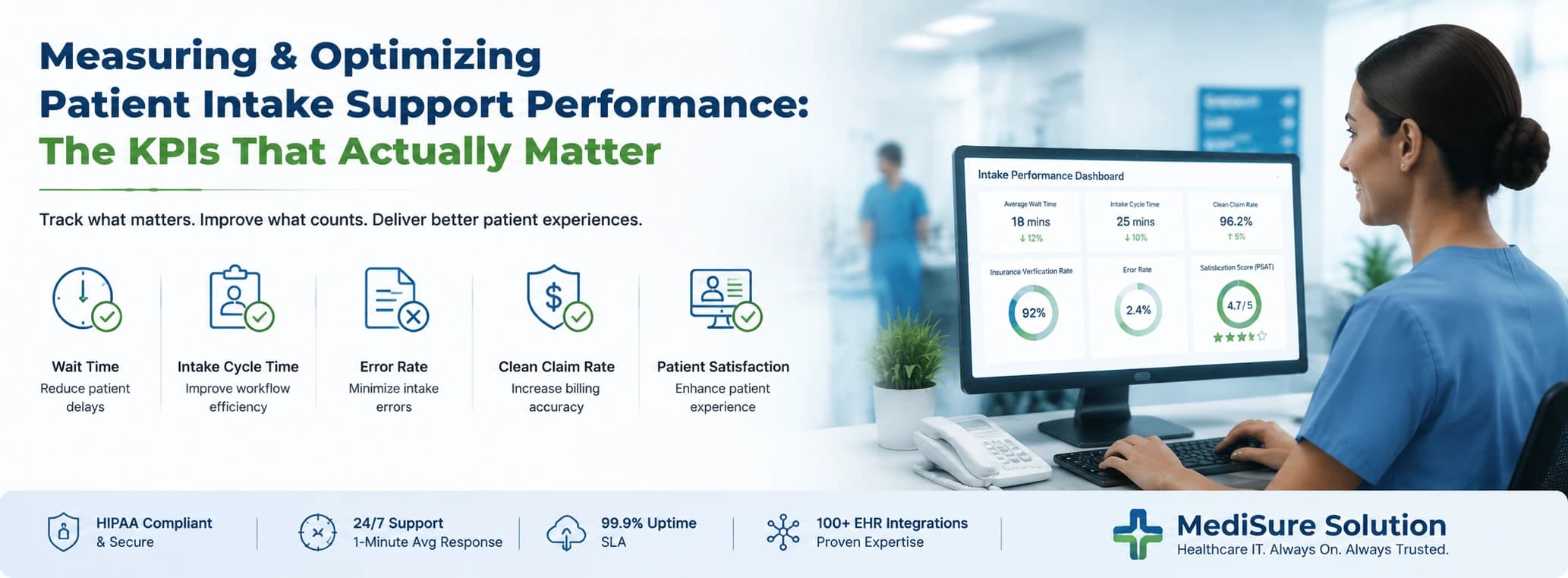
Industry estimates suggest that operational metrics such as wait times, intake cycle duration, clean claim rates, and patient satisfaction scores are among the strongest indicators of intake performance and administrative efficiency (HIMSS, Becker’s Healthcare). Industry guidance also emphasizes that organizations balancing quantitative metrics with patient experience measures are better positioned to identify operational bottlenecks before they become systemic issues (KLAS, HIMSS).
For healthcare leaders responsible for patient access operations, tracking patient intake support KPIs is no longer a reporting exercise. It is a strategic function that directly impacts workflow continuity, SLA compliance, infrastructure utilization, and operational scalability.
The challenge is determining which metrics truly matter, how they should be measured, and how healthcare organizations can optimize them without increasing administrative burden.
Why Healthcare Organizations Are Struggling With Patient Intake Performance Visibility
Most healthcare organizations collect intake-related data. Far fewer organizations transform that data into operational intelligence.
An IT Director managing multiple hospital locations often struggles to gain a unified view of wait times, intake bottlenecks, and registration quality across facilities. A Clinical Informatics Manager supporting Cerner or Athenahealth environments may find that intake performance metrics are spread across disconnected systems with limited reporting consistency.
A clinic running eClinicalWorks without dedicated operational analytics support frequently lacks visibility into how patient satisfaction, error rate trends, and SLA compliance interact with one another. Teams may know that intake delays exist but cannot identify their root causes.
The growing adoption of digital intake platforms has created additional complexity. More patient interactions now occur through portals, mobile devices, automated scheduling tools, and remote registration workflows. Without centralized monitoring and governance, healthcare organizations often struggle to understand whether technology investments are actually improving operational performance.
As healthcare delivery models become increasingly distributed, intake visibility has become a critical operational requirement rather than a reporting convenience.
Why Wait Times Reveal More About Operational Health Than Most IT Dashboards
Many healthcare leaders view wait times as a patient experience metric. In reality, they are often an early warning signal for deeper workflow, integration, and infrastructure issues.
Extended delays can originate from multiple sources including EHR synchronization failures, slow insurance verification processes, incomplete digital forms, staffing shortages, or application performance issues. When systems supporting intake workflows fail to communicate effectively through HL7 FHIR, HL7 v2.x, or CDA-based exchanges, delays frequently surface first at the registration desk.
Industry guidance consistently identifies wait times as one of the strongest drivers of patient satisfaction and perceived service quality (HIMSS, Becker’s Healthcare). Similarly, intake cycle time remains a critical operational benchmark because it measures how efficiently patients move from registration to provider readiness (HIMSS).
MediSure Solution’s experience supporting more than 100 healthcare organizations and over 10 hospitals demonstrates that organizations with proactive infrastructure monitoring identify intake slowdowns significantly earlier than those relying on reactive troubleshooting. Maintaining a 99.9% uptime SLA and a one-minute average response time helps minimize disruptions that can contribute to intake delays.
What this means for Healthcare CIOs and Directors of IT Operations is that wait times should be treated as a cross-functional operational KPI, not merely a front-desk metric. The root cause often resides within infrastructure, integrations, workflows, or support responsiveness.
MediSure Solution’s 24/7 Managed IT services help healthcare organizations maintain operational continuity and proactively address performance issues before they impact intake workflows.
The Most Expensive Intake Errors Are the Ones That Reach Billing
Organizations frequently focus on registration speed while overlooking accuracy. Yet intake errors often create downstream consequences that are significantly more costly than a few additional minutes spent validating information.
Data quality issues introduced during intake can affect insurance verification, authorization workflows, scheduling accuracy, and claim submission processes. In environments where EHR systems exchange information with laboratory systems, PACS platforms, billing applications, and referral networks, a single inaccurate data point can trigger extensive rework.
Industry guidance identifies clean claim rate, insurance verification rate, and first-pass accuracy as foundational intake performance indicators because they reflect how effectively patient information is captured at the front end of the workflow (HIMSS, Becker’s Healthcare).
MediSure Solution’s support for more than 100 EHR integrations has consistently reinforced a critical lesson: organizations achieving stronger intake performance focus on workflow standardization and interoperability, not just staff productivity. Systems integrated through properly governed HL7 FHIR and HL7 v2.x workflows reduce opportunities for manual data-entry errors while supporting HIPAA-aligned data handling practices.
What this means for Clinical Informatics Managers and Practice Administrators is that error rate tracking should extend beyond registration metrics. The most valuable KPI is often the number of downstream workflows affected by intake inaccuracies.
Healthcare organizations seeking stronger intake accuracy often align EHR optimization initiatives with MediSure Solution’s EHR Support services to improve workflow consistency and data integrity.
Patient Intake Performance Metrics That Matter Most
| KPI | Operational Purpose | Business Impact |
|---|---|---|
| Wait Time | Measures patient delay before provider interaction | Influences satisfaction and workflow efficiency |
| Intake Cycle Time | Tracks registration-to-provider readiness | Identifies bottlenecks |
| Error Rate | Measures failed or inaccurate transactions | Impacts claims and rework |
| Clean Claim Rate | Assesses intake data quality | Supports revenue cycle efficiency |
| Insurance Verification Rate | Confirms eligibility before visits | Reduces billing disruptions |
| Patient Satisfaction (CSAT/PSAT) | Measures patient perception | Evaluates service quality |
| SLA Compliance | Tracks contractual service performance | Supports accountability |
| Abandonment Rate | Measures incomplete registrations | Identifies friction points |
SLA Compliance Is Meaningless Without Operational Accountability
Healthcare organizations often evaluate intake support providers based on SLA percentages alone. That approach frequently misses the larger operational picture.
A provider can technically meet response-time obligations while still creating workflow disruptions if incident escalation processes are weak, root-cause investigations are inconsistent, or corrective actions are poorly managed. Effective patient intake support depends on operational maturity, not simply contractual compliance.
Industry guidance recommends anchoring SLA frameworks to meaningful business outcomes rather than measuring excessive numbers of disconnected metrics (Gartner, HIMSS). Error resolution quality, communication effectiveness, escalation responsiveness, and service continuity often provide more operational value than isolated response-time statistics.
MediSure Solution supports healthcare organizations with a documented 99.9% uptime SLA, HIPAA-focused operational practices, and a one-minute average response time. Equally important, healthcare environments require structured incident escalation procedures that maintain continuity across EHR platforms, registration systems, scheduling applications, and supporting infrastructure.
What this means for Healthcare Startup CTOs, Hospital IT Directors, and Operations Leaders is that choosing the right provider should involve evaluating accountability models, collaboration practices, and long-term operational alignment rather than comparing SLA percentages alone.
Organizations evaluating healthcare IT partners should consider how operational governance, responsiveness, and healthcare-specific expertise contribute to long-term intake performance stability.
Disaster Recovery Determines Whether Intake Operations Survive a Crisis
Most patient intake workflows perform adequately during normal operations. The true test occurs during cyber incidents, infrastructure failures, power disruptions, or unexpected outages.
Patient intake systems depend on interconnected technologies including EHR platforms, scheduling systems, insurance verification tools, communication platforms, and cloud-hosted applications. Without a comprehensive disaster recovery strategy, a single disruption can halt patient access operations across multiple facilities.
Industry guidance consistently emphasizes that Recovery Time Objective (RTO) and Recovery Point Objective (RPO) should drive disaster recovery planning and business continuity strategies (HHS, Gartner). Equally important, failover testing, backup verification, and documented recovery procedures provide auditable proof that recovery processes function as intended.
MediSure Solution’s experience supporting hospitals, clinics, laboratories, and healthcare startups highlights a recurring reality: organizations that regularly test failover procedures recover more predictably than those relying solely on documentation. Disaster recovery planning must also account for HIPAA requirements, data retention policies, and continuity obligations across interconnected healthcare systems.
What this means for IT Directors and Healthcare Executives is that disaster recovery should be evaluated as a patient access initiative as much as an infrastructure initiative. If intake operations cannot recover quickly, scheduling, registration, billing, and communication workflows are immediately affected.
Healthcare organizations seeking stronger operational resilience often pair intake optimization efforts with MediSure Solution’s Server Management and disaster recovery support services.
MediSure Solution’s editorial content is developed by practitioners with direct experience supporting hospitals, medical centers, laboratories, and healthcare startups across the United States. Our insights are grounded in real operational engagements involving EHR environments, interoperability frameworks, disaster recovery planning, and healthcare infrastructure management—not theoretical frameworks.
Building a KPI Framework That Scales With Healthcare Growth
Healthcare IT environments are under more pressure than ever before. Organizations are expected to improve patient experience, support digital transformation initiatives, maintain compliance, and scale operations without compromising service continuity.
Over the next two to three years, patient intake operations will become increasingly data-driven. AI-assisted intake workflows, predictive analytics, automated insurance verification, and integrated patient engagement platforms will create new opportunities to optimize performance. However, these technologies will only deliver value when supported by reliable infrastructure, measurable KPIs, and disciplined operational governance.
At MediSure Solution, we believe patient intake performance should be measured through a balanced framework that combines operational efficiency, data accuracy, patient experience, SLA accountability, and disaster recovery readiness.
We help hospitals, clinics, laboratories, healthcare startups, and life sciences organizations stay operational, compliant, and ahead of downtime through 24/7 managed IT, EHR support, network management, server management, and legacy migration services.
MediSure Solution helps healthcare organizations stay operational, compliant, and ahead of downtime — get 24/7 support here.