When patient intake processes fail in a healthcare environment, the cost is not measured in dollars alone. Registration delays, incomplete records, insurance verification issues, and administrative bottlenecks can ripple across entire clinical operations, affecting scheduling efficiency and workflow continuity.
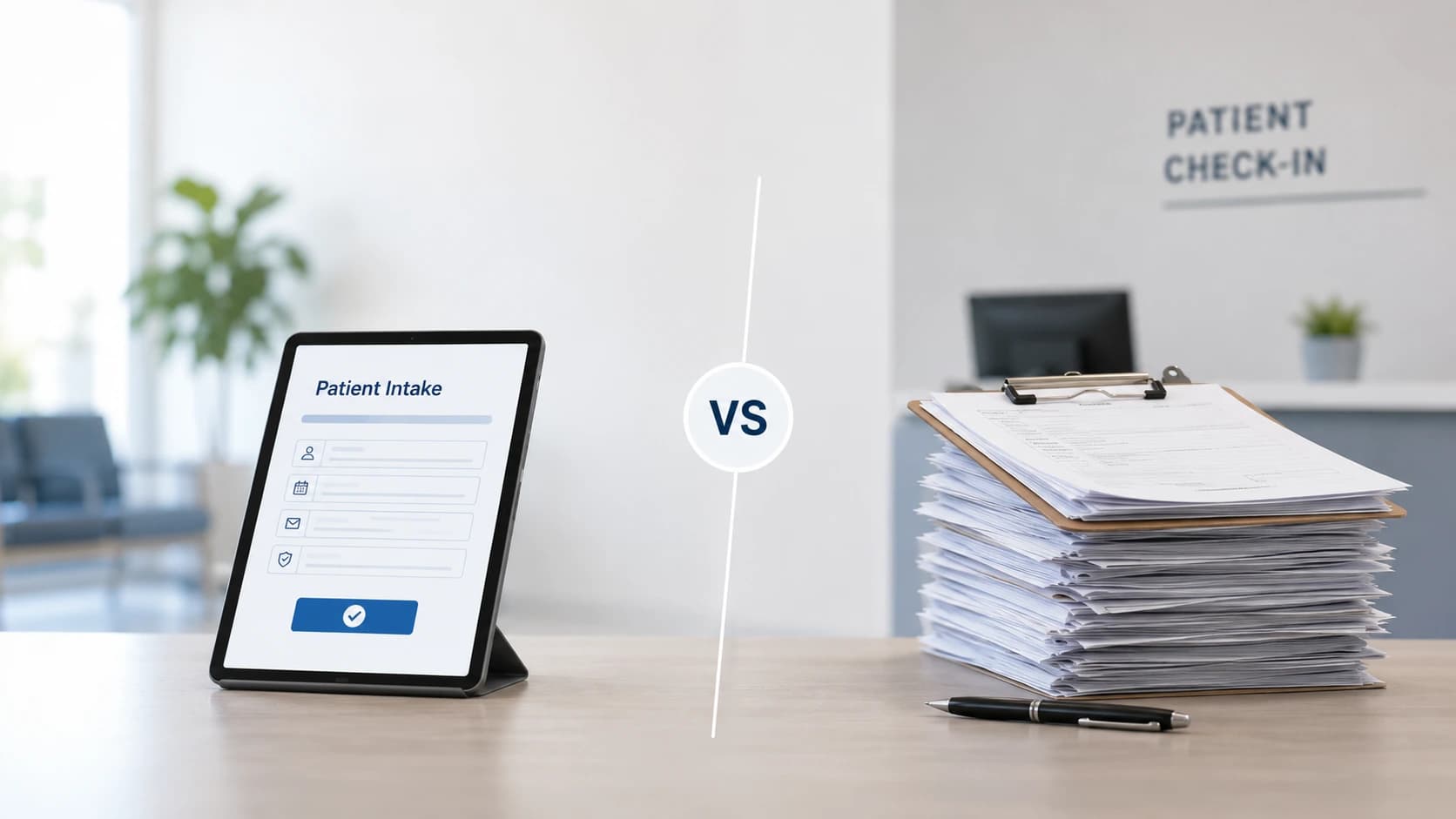
Industry data suggests that patients can complete digital intake forms in as little as 5–10 minutes, compared to 15–20 minutes typically required for traditional waiting-room paperwork. Research also indicates that staff processing time can decrease from approximately 10–15 minutes per patient to as little as 0–2 minutes when intake information flows directly into Electronic Health Records (EHR) systems through automation (HIMSS industry estimates).
For Hospital IT Directors, Clinical Informatics Managers, and Healthcare CIOs, the challenge is no longer whether intake modernization is possible. The real question is which approach delivers the operational efficiency, scalability, and workflow reliability healthcare organizations need today. This guide examines the differences between patient intake support and manual intake processes to help healthcare leaders make informed technology decisions.
Why Healthcare Organizations Are Struggling With Intake Workflow Inefficiencies
Healthcare organizations depend on accurate patient information to support scheduling, registration, billing, compliance, and clinical workflows. Yet many organizations continue to rely on manual intake processes that were designed for a healthcare environment that no longer exists.
An IT Director managing multiple hospital locations cannot effectively scale operations when registration teams spend significant time processing paper forms and correcting incomplete submissions. A clinic running on a single EHR platform without integrated intake workflows often struggles with duplicate data entry and inconsistent patient records. A Clinical Informatics Manager responsible for maintaining workflow integrity must constantly balance operational efficiency with compliance requirements.
The problem is not simply paperwork. It is the growing disconnect between patient expectations, healthcare operational demands, and legacy administrative processes. Patients increasingly expect digital interactions, while healthcare organizations require accurate data, seamless integrations, and efficient workflows that support care delivery continuity.
As patient volumes grow and staffing pressures continue, healthcare leaders must evaluate whether traditional manual intake can still support modern operational requirements.
Manual Intake Creates Hidden Operational Costs That Extend Beyond Registration
Many healthcare organizations view manual intake as a familiar and low-cost process. However, the operational burden associated with paper-based workflows often extends far beyond the waiting room.
Manual intake depends heavily on front-desk teams to distribute forms, collect paperwork, verify information, and manually enter data into systems. Every handoff introduces opportunities for delays, incomplete records, and administrative inefficiencies. Paper documents can be misplaced, handwriting may be difficult to interpret, and missing signatures frequently require additional follow-up.
Industry estimates indicate that manual administrative intake tasks can cost healthcare organizations between $4 and $6 per patient in staff processing time alone, excluding printing, scanning, storage, and paper-related expenses. Industry data also suggests that approximately 50% of claim rejections can be traced back to errors originating during the intake process, including incorrect demographic information and insurance details (Healthcare Revenue Cycle Management estimates).
What this means for Healthcare CIOs, Practice Managers, and Directors of IT Operations is that manual intake creates ongoing operational expenses that are often hidden within administrative workflows. While paper processes may appear simple, they frequently increase workload, create inefficiencies, and contribute to downstream revenue cycle challenges.
MediSure Solution’s 24/7 Managed IT and EHR Support services help healthcare organizations eliminate workflow inefficiencies through integrated healthcare technology solutions — visit medisuresolution.com.
Digital Patient Intake Reduces Errors Before They Reach Clinical Systems
Accurate patient information is critical to healthcare operations. When incorrect data enters a system, the impact extends beyond registration and affects scheduling, billing, reporting, and operational workflows.
Digital patient intake platforms address this challenge by collecting information electronically before the patient arrives. Built-in validation logic ensures required fields are completed and information is submitted in the correct format. Once completed, data flows directly into EHR systems such as Cerner, Athenahealth, and eClinicalWorks through integrated workflows utilizing standards such as HL7 FHIR, HL7 v2.x, and CDA.
Industry estimates suggest that manual intake workflows can experience error rates approaching 20%, while digital intake systems can reduce data-entry errors to approximately 0.67% through validation controls and automated data transfer processes. Research also indicates that transcription and registration mistakes contribute significantly to claim denials and administrative rework across healthcare organizations (HIMSS industry estimates).
What this means for Hospital IT Directors and Clinical Informatics Managers is improved data quality across enterprise systems. Fewer intake errors result in cleaner records, more reliable workflows, and reduced administrative intervention throughout the patient journey.
MediSure Solution helps healthcare organizations maintain secure, HIPAA-compliant integrations between intake platforms and EHR environments with reliable 24/7 technical support — learn more at medisuresolution.com.
Workflow Automation Delivers Greater Intake Efficiency at Scale
The most significant difference between patient intake support and manual intake is not the form itself. It is the automation that surrounds the process.
Modern intake platforms automate administrative functions that traditionally consume significant staff time. Appointment reminders, insurance eligibility verification, consent collection, and patient communications can all occur before a patient arrives. Automated workflows eliminate repetitive manual tasks while creating a more consistent operational process.
Industry data suggests that patients using digital intake solutions can complete forms in approximately 5–10 minutes compared to the 15–20 minutes commonly required for paper-based registration. Staff processing time can also decline from 10–15 minutes per patient to just 0–2 minutes when data automatically synchronizes with healthcare systems (Healthcare IT workflow automation estimates).
What this means for Healthcare CIOs, Practice Administrators, and Healthcare Startup CTOs is greater scalability. As patient volumes increase, organizations can process more registrations without proportionally increasing administrative staffing requirements. Workflow automation transforms intake from a resource-intensive administrative task into a streamlined digital process.
MediSure Solution supports healthcare organizations with 24/7 managed IT services, EHR support, network management, and workflow integration expertise designed to keep critical systems operational around the clock — visit medisuresolution.com.
The Best Intake Strategy Is Often Digital-First With a Controlled Manual Fallback
The debate is not always digital versus paper. For many healthcare organizations, the most effective approach is a digital-first strategy supported by a controlled manual fallback process.
Digital intake systems provide the speed, automation, and scalability required for modern healthcare operations. At the same time, some patient populations may still require paper alternatives due to accessibility preferences or technology limitations. Successful healthcare organizations accommodate both while ensuring digital workflows remain the primary operational pathway.
Modern intake platforms also strengthen security and compliance by replacing physical paperwork with encrypted digital records and controlled access environments. HIPAA-compliant workflows reduce the risk of document loss while improving auditability and governance across patient registration processes.
What this means for healthcare decision-makers is that implementation success depends on workflow design rather than technology alone. Organizations should evaluate existing intake processes, identify bottlenecks, and prioritize solutions that integrate seamlessly with their EHR and practice management systems. The objective is not simply digitization—it is operational optimization.
MediSure Solution helps healthcare organizations design, implement, and support secure intake ecosystems that align with existing EHR workflows and long-term digital transformation goals — learn more at medisuresolution.com.
Conclusion
Healthcare IT environments are under more pressure than ever before. Growing patient expectations, staffing constraints, increasing administrative complexity, and evolving compliance requirements are forcing organizations to rethink how patient information is collected and managed.
The future of healthcare intake is moving toward automation, interoperability, and seamless integration with enterprise healthcare systems. Organizations that continue relying exclusively on manual workflows may struggle to achieve the operational efficiency and scalability required to support long-term growth.
Patient intake support systems provide measurable advantages in data accuracy, workflow efficiency, administrative workload reduction, and operational consistency. While manual intake may continue serving as a backup option for select patient populations, digital-first workflows are increasingly becoming the standard for healthcare organizations focused on modernization.
MediSure Solution helps hospitals, clinics, laboratories, healthcare startups, and healthcare enterprises stay operational, compliant, and ahead of downtime with 24/7 managed IT, EHR support, network management, server support, and legacy data migration services — get 24/7 support at medisuresolution.com.